Our Favorite Movie Supervillains
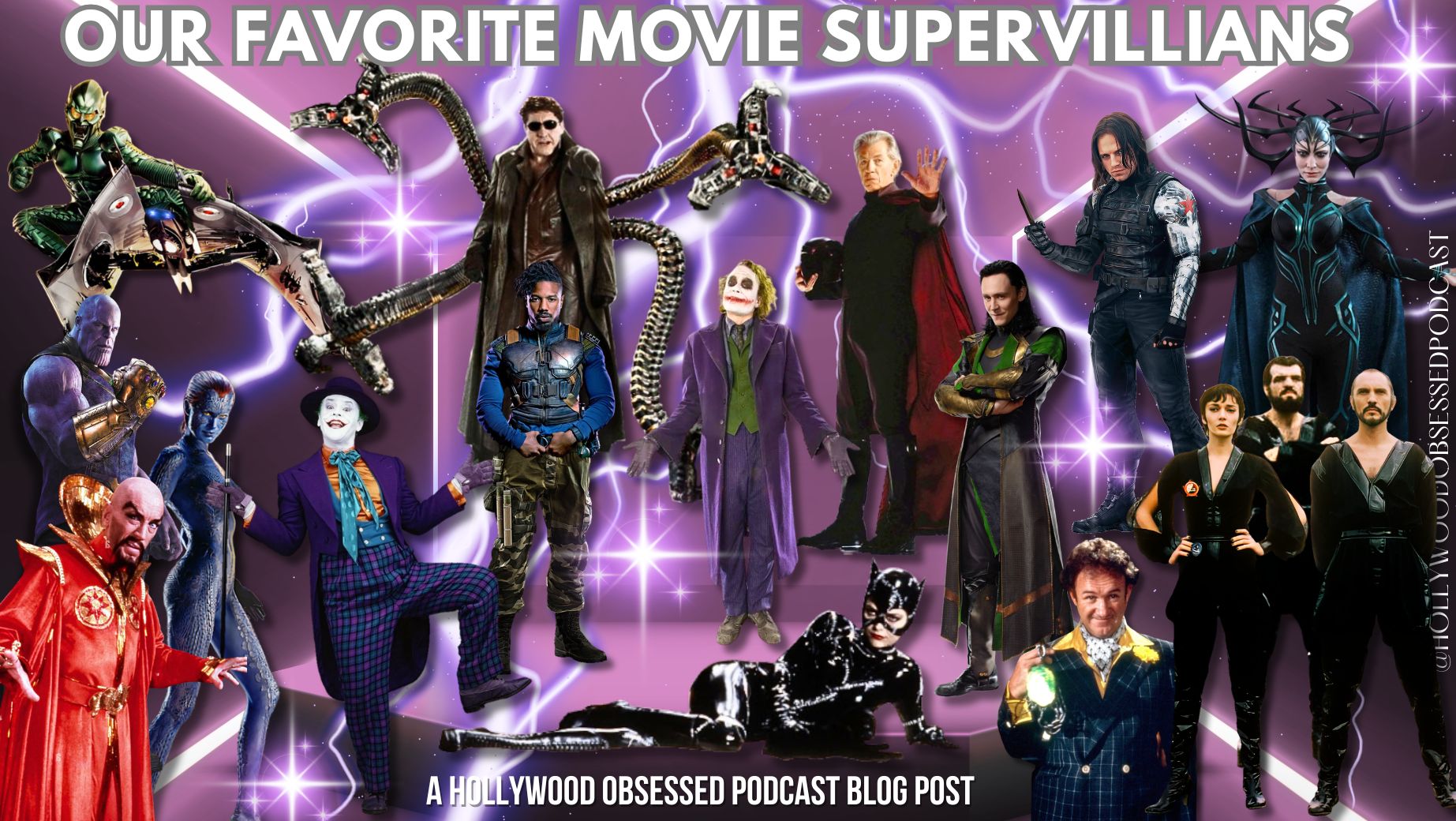
For the past several decades, moviegoers have been treated to an extraordinary wave of superhero films, thanks largely to the cinematic worlds created by DC Studios and Marvel Studios. These larger-than-life adventures have transported us to worlds of heroic feats, cosmic battles, and unforgettable spectacle. But as thrilling as superheroes may be, every great hero needs an equally great villain. Without a worthy adversary, even the mightiest champion is just someone in an impressive costume with nowhere to go.
And when it comes to stealing the spotlight, supervillains often do exactly that. They are charismatic, unpredictable, and irresistibly entertaining, often delivering the sharpest dialogue and the most memorable moments. Whether they are pursuing world domination, exacting revenge, or simply reveling in their own wickedness, these iconic antagonists frequently become the true stars of the story.
My fascination with great movie villains began early. Watching “Superman: The Movie”, I was captivated by Lex Luthor’s battle of wits with the Man of Steel. Then “Superman II” introduced the unforgettable Kryptonian trio of General Zod, Ursa, and Non, whose icy menace and theatrical flair made them utterly irresistible. Their larger-than-life presence cemented my lifelong appreciation for the art of the cinematic supervillain.
That passion came full circle when I recently had the pleasure of interviewing Sarah Douglas, who played the unforgettable Ursa in both films, for a two-part episode of Hollywood Obsessed. Inspired by that wonderful conversation, I thought it would be great fun to celebrate some of our all-time favorite movie supervillains—from Loki and Ming the Merciless to Hela and Magneto. So cue the ominous music and prepare to honor the masters of mayhem, the monarchs of menace, and the true scene-stealers of superhero cinema.
*************************************************
General Zod, Ursa, and Non (Superman: The Movie and Superman II)
Before Superman ever squared off against high-tech tycoons or monstrous mutants, he faced his greatest challenge: three Kryptonian criminals with all of his powers and none of his conscience. General Zod, Ursa, and Non, as seen in “Superman II”, are the ultimate evil super-team—banished from Krypton to the Phantom Zone, only to escape and arrive on Earth ready to conquer. Under our yellow sun, they gain the same incredible abilities as Superman, making them a terrifying triple threat.
Leading the charge is General Zod, played with icy brilliance by Terence Stamp. He is the cold, calculating mastermind, determined to reshape the world in his own authoritarian image. At his side is Ursa, portrayed by Sarah Douglas, whose fierce intelligence, cunning, and delightfully cruel nature make her every bit as dangerous as Zod. She takes particular pleasure in tormenting humans, adding a wicked sense of fun to her menace. And then there’s Non, brought to life by Jack O’Halloran, a silent but devastating force of nature—a Kryptonian wrecking ball clad in black leather boots.
What makes these three such unforgettable villains is that they are Superman’s dark mirror. They share his origins, his powers, and his connection to Krypton, but where Superman chooses compassion and heroism, they choose domination and destruction. They represent everything he could have become without his humanity. And, of course, it doesn’t hurt that they do it all with impeccable style—proof that world conquest is always better when dressed for the occasion.
While General Zod returned in the 2013 film “Man of Steel”, the original trio remains unmatched. No one has captured that same blend of theatricality, menace, and pure comic-book grandeur quite like these three.
For more behind-the-scenes stories from these classic Superman films, be sure to check out my two-part conversation with Sarah Douglas on Episodes 167 and 168 of Hollywood Obsessed.
CLICK HERE TO LISTEN NOW
And remember: kneel before Zod… or at least keep reading to discover who else made our list of favorite movie supervillains.
⸻
Loki (Thor, The Avengers, and Thor: Ragnarok)
Loki is one of our favorite supervillains because, beneath all the mischief and mayhem, he’s surprisingly human. Unlike villains driven by simple world domination, Loki’s actions are fueled by something far more relatable: a desperate need to be seen, valued, and loved. Growing up in the shadow of his mighty brother Thor left him feeling overlooked and out of place, and that emotional wound makes his villainy feel less monstrous and far more tragic.
Of course, it doesn’t hurt that Loki is endlessly entertaining. He’s clever, unpredictable, and deliciously mischievous—a villain who prefers outsmarting his enemies to overpowering them. His razor-sharp wit, flair for drama, and chaotic trickster energy make him one of the Marvel Cinematic Universe’s most captivating characters. Whether he’s conquering Earth or simply delivering a perfectly timed sarcastic remark, he always steals the scene.
What truly elevates Loki above the average comic-book bad guy is his evolution. Over the years, he’s transformed from jealous antagonist to reluctant ally, grieving son, and ultimately, a hero capable of great sacrifice. Actor Tom Hiddleston brings all of that complexity to life with irresistible charisma, balancing Shakespearean gravitas with playful charm. Loki isn’t just a villain—we root for him because, like all of us, he’s simply trying to figure out who he really is.
⸻
Ming The Merciless (Flash Gordon)
The 1980 Sci-Fi film “Flash Gordon” gave audiences one of cinema’s most gloriously unapologetic villains in Ming the Merciless. Unlike many modern antagonists, Ming doesn’t need a tragic backstory or a tortured soul to explain his evil. He is driven by pure ego, absolute authority, and an insatiable hunger for power. He rules through fear, destroys worlds on a whim, and treats entire civilizations as little more than pieces in his personal game. There’s something wonderfully old-school about a villain who is simply, magnificently wicked.
A huge part of Ming’s enduring appeal comes from the commanding performance of Oscar nominated Max von Sydow. He brought an air of regal menace and operatic grandeur to the role, delivering every line with icy precision and imperial confidence. While the film around him revels in dazzling camp and larger-than-life spectacle, von Sydow remains perfectly composed at its center. His calm, controlled cruelty makes Ming all the more intimidating—and all the more unforgettable.
What makes Ming especially formidable is that his greatest weapons are not brute strength or superhuman abilities, but his intelligence, vast resources, and unquestioned authority. He is a master strategist, a ruthless ruler, and a tyrant who bends entire worlds to his will. And in the film, his mystical power ring adds an extra layer of menace, granting him supernatural abilities that make him seem even more godlike. In short, Ming the Merciless is the ultimate movie supervillain: elegant, terrifying, and deliciously evil.
⸻
Catwoman (Batman Returns)
The 1992 Tim Burton classic film “Batman Returns” gave us many unforgettable things—penguin armies, gothic grandeur, and one of the greatest comic-book performances ever captured on film. As Michelle Pfeiffer’s Catwoman, Selina Kyle became far more than a standard villain. Pfeiffer transformed her into a complex, wounded, and irresistibly dangerous antihero: part femme fatale, part avenging angel, and wholly unforgettable. With her stitched-together vinyl suit, razor-sharp wit, and seductive menace, she created the definitive cinematic Catwoman.
What makes Catwoman so compelling is that her story is rooted not in world domination, but in personal rebellion. Selina begins as a timid, overlooked secretary, crushed by the very world that exploits her. After Max Shreck’s betrayal, her transformation into Catwoman becomes a furious rejection of every expectation placed upon her. She channels years of repression, anger, and humiliation into power, turning vulnerability into strength and weaponizing the very qualities society once tried to control.
And then there’s Pfeiffer’s extraordinary commitment to the role. She performed many of her own stunts, famously cracking the heads off a row of mannequins with a whip in a single take, and even put a live bird in her mouth for one unforgettable scene. But beyond the spectacle, Catwoman endures because she is deeply human. She isn’t bent on conquering the world; she wants justice, revenge, and autonomy. Her electric connection with Batman challenges him in ways no other villain can, making her not just one of his greatest adversaries, but one of cinema’s most captivating supervillains—purrrfectly worthy of a place among our favorites.
⸻
The Winter Soldier (Captain America: The Winter Soldier)
His introduction in “Captain America: The Winter Soldier” remains iconic for its high-intensity, practical hand-to-hand combat, such as the initial siege on Nick Fury. He remains one of our favorite movie supervillains because he is far more than just a relentless assassin—he is a tragedy in motion. As portrayed with remarkable intensity by Sebastian Stan, he is a near-unstoppable force, a silent weapon whose every movement radiates danger. Yet beneath the metal arm and icy stare lies the shattered soul of Bucky Barnes, a man robbed of his identity and transformed into a tool of destruction. That heartbreaking duality makes him as sympathetic as he is terrifying.
What makes him especially compelling is that he serves as the perfect dark reflection of Captain America. Both are loyal soldiers shaped by war, but while Steve Rogers represents hope, heroism, and free will, the Winter Soldier embodies the devastating consequences of those same virtues being twisted and exploited. Stan’s haunting performance—often conveyed through little more than a glance, a posture, or a flicker of recognition—reveals the humanity buried beneath the programming. He is not evil by choice, but by design, and that tragic conflict is exactly what elevates him from a formidable villain to one of the most unforgettable in superhero cinema.
⸻
Lex Luthor (Superman The Movie)
Lex Luthor, as portrayed by Gene Hackman in the classic Superman films, remains one of our favorite movie supervillains precisely because he proves that true power doesn’t always come from superhuman abilities. Armed only with his towering intellect, boundless ego, and relentless ambition, Luthor sees himself as Superman’s equal—if not his superior. Hackman brilliantly reimagined the character, trading the usual icy, calculating mastermind for a flamboyant, fast-talking criminal genius who relishes every moment of his villainy. As the self-proclaimed “greatest criminal mind of our time,” his confidence is as immense as his schemes.
What makes Hackman’s Luthor so unforgettable is how irresistibly entertaining he is. He brings a mischievous charm, razor-sharp wit, and theatrical flair to every scene, making him as fun to watch as he is dangerous. Whether he’s delivering a perfectly timed one-liner or plotting world domination, he radiates a gleeful sense of mischief. His hilarious interactions with his loyal but dimwitted henchman Otis and the ever-glamorous Miss Teschmacher add even more personality, creating some of the franchise’s most memorable moments. After all, a supervillain with a wicked sense of humor is always far more enjoyable—and far more unforgettable.
⸻
Hela (Thor: Ragnarok)
Hela, brought magnificently to life by Cate Blanchett in “Thor: Ragnarok,” is one of our favorite movie supervillains because she is the complete package: powerful, stylish, and utterly commanding. As the Marvel Cinematic Universe’s first major female villain, Hela immediately shattered expectations—and not just metaphorically. Her unforgettable entrance, in which she casually destroys Thor’s mighty hammer, instantly established her as a threat unlike any the MCU had seen before. With her gothic elegance, razor-sharp wit, and terrifying strength, she doesn’t simply enter the story—she takes it over.
What makes Hela especially compelling is that she is far more than a force of destruction. She is the living embodiment of Asgard’s buried sins, the dark legacy of conquest and bloodshed that Odin tried to erase from history. As his firstborn and former executioner, Hela forces Asgard—and its heroes—to confront an uncomfortable truth about their own past. Cate Blanchett’s performance is a masterclass in villainy, balancing regal poise, wicked humor, and gleeful cruelty in every scene. She is so formidable that Thor and Loki cannot defeat her through strength alone; instead, they must unleash Ragnarök itself to stop her. When a villain is so powerful that the only way to win is to destroy your own world, that’s the mark of a truly legendary supervillain.
⸻
The Joker (Batman)
Joker, as portrayed by Jack Nicholson in the 1989 film “Batman”, remains one of our favorite movie supervillains because he perfectly balances outrageous comic-book flair with genuine menace. Nicholson understood that the Joker should be equal parts entertainer and nightmare, and he delivered a performance that was both wildly theatrical and deeply unsettling. Every scene feels like his personal stage, whether he’s turning a museum into his own twisted art exhibit or unleashing chaos on Gotham with a grin as wide as his criminal ambitions. He’s hilarious, terrifying, and utterly impossible to look away from.
What makes Nicholson’s Joker truly legendary is the sheer joy he takes in being evil. He revels in every wicked act, transforming villainy into a grand performance filled with dark humor, unforgettable one-liners, and larger-than-life charisma. His iconic lines have become part of pop culture history, and his portrayal helped redefine what a comic-book movie villain could be. More importantly, Nicholson’s star power brought a new level of prestige to superhero films, proving that these stories could attract top-tier talent and deliver rich, character-driven entertainment. His Joker didn’t just leave an impression—he set the gold standard for cinematic supervillains, and we loved every gloriously unhinged minute of it.
⸻
Doctor Octopus (Spider-Man 2)
Doctor Octopus, brought to life with remarkable depth by Alfred Molina in “Spider-Man 2,” remains one of our favorite movie supervillains because he is, at his core, a tragic figure rather than a purely evil one. Otto Octavius begins as a brilliant scientist, a loving husband, and a mentor Peter Parker genuinely admires. That makes his fall all the more devastating. Driven by the loss of his wife and the corrupting influence of his mechanical arms, Otto’s transformation into Doctor Octopus is as heartbreaking as it is terrifying. He isn’t simply a villain to be defeated—he’s a good man losing a battle with his own creation.
What makes Molina’s performance so unforgettable is the humanity he brings to every moment. He portrays Otto as a man torn between his better nature and the destructive obsession consuming him, allowing us to see the struggle still raging within. His intelligence and ambition mirror Peter’s own, making their conflict feel deeply personal—a clash not just of strength, but of ideals. Both men are driven by dreams of making the world better, yet their paths diverge when responsibility and ambition collide. In the end, Doctor Octopus stands as one of the genre’s most compelling villains because his story reminds us that the line between hero and villain can be heartbreakingly thin.
⸻
Killmonger (Black Panther)
Erik "Killmonger" Stevens, portrayed with extraordinary intensity by Michael B. Jordan in “Black Panther,” stands as one of our favorite movie supervillains because he is far more than a simple antagonist—he is a deeply tragic and profoundly human figure. His anger is rooted in abandonment, loss, and the painful reality of systemic injustice. As the son of Wakanda, left behind and denied his birthright, Killmonger embodies the consequences of a nation turning inward while others suffer. His grievances are not without merit, which makes his actions all the more compelling. He challenges not only the hero, but the very ideals Wakanda has built itself upon.
What makes Killmonger truly unforgettable is that he is both intellectually and physically formidable. He defeats T’Challa in ritual combat, seizes the throne, and forces Wakanda to confront uncomfortable truths about its own isolation and responsibility to the wider world. Michael B. Jordan delivers a magnetic performance, blending swagger, intelligence, rage, and vulnerability into a character who commands every scene. Killmonger’s vision stands in direct opposition to T’Challa’s, yet both perspectives are understandable, making their conflict as philosophical as it is personal. The best villains leave a lasting impact on the hero, and Killmonger does exactly that—his challenge transforms T’Challa, reshapes Wakanda, and cements his place as one of the greatest supervillains in cinematic history.
⸻
Magneto (X-Men Franchise)
Magneto, as portrayed by Ian McKellen in the “X-Men” franchise, is one of our favorite movie supervillains because he is never merely evil—he is profoundly human. McKellen transformed Magneto from a traditional comic-book antagonist into a deeply layered ideological adversary whose motivations are rooted in pain, loss, and survival. As a Holocaust survivor, Erik Lehnsherr has witnessed the horrors of persecution firsthand, and his fierce “never again” philosophy makes his actions understandable, even when they are morally indefensible. His fear of mutant extinction is not paranoia; it is born from lived trauma, which gives his worldview a powerful and unsettling authenticity.
What makes McKellen’s Magneto so unforgettable is the extraordinary gravitas, intelligence, and charisma he brings to the role. He is regal, articulate, and utterly convinced that he is fighting for the future of his people. Rather than ruling through fear alone, Magneto inspires loyalty through conviction, logic, and force of personality. His complex friendship with Charles Xavier—beautifully played by Patrick Stewart—adds even greater emotional depth, as their bond endures despite their bitter ideological divide. They are not simply enemies, but old friends whose shared dream for mutantkind has taken radically different paths. That tension, combined with Magneto’s tragic history and unwavering conviction, makes him one of cinema’s most compelling and unforgettable supervillains.
⸻
Green Goblin (Spider-Man & Spider-Man: No Way Home)
Green Goblin, brought to terrifying life by Willem Dafoe in 2002’s “Spider-Man” and later in 2021’s “Spider-Man: No Way Home,” remains one of our favorite movie supervillains because he embodies the perfect blend of tragedy, menace, and chaos. Dafoe’s performance captures the heartbreaking divide between Norman Osborn—the brilliant scientist and caring father figure—and the Green Goblin, a gleefully sadistic force of destruction. Few villains feel so completely unhinged while still retaining traces of the humanity beneath the madness. His now-legendary mirror scene remains a masterclass in acting, as Dafoe seamlessly shifts between Norman’s fear and the Goblin’s malevolent delight with nothing more than his voice, expression, and sheer presence.
What makes the Green Goblin especially compelling is how deeply personal his conflict with Spider-Man becomes. Norman is a dark reflection of Peter Parker, representing what can happen when power is divorced from responsibility. He doesn’t seek conquest for its own sake; he wants to break Peter emotionally, targeting the people he loves and forcing him to confront impossible choices. That psychological cruelty makes him far more dangerous than a typical supervillain. Dafoe’s fearless, theatrical approach—combined with his willingness to perform many of his own stunts—gives the Goblin a feral, unpredictable energy that still feels electrifying decades later. His triumphant return in No Way Home only reaffirmed what fans already knew: the Green Goblin isn’t just one of Spider-Man’s greatest enemies—he is one of cinema’s greatest villains.
⸻
Thanos (Avengers: Infinity Wars & Avengers: Endgame)
Thanos, portrayed with remarkable depth by Josh Brolin in 2018’s “Avengers: Infinity War” and 2019’s “Avengers: Endgame,” stands as one of our favorite movie supervillains because he is far more than a simple force of destruction. Thanos sees himself not as a conqueror, but as a savior—a tragic figure burdened by a mission he believes is essential for the survival of the universe. His horrifying plan is rooted in a twisted but internally consistent philosophy, shaped by the fall of his home world, Titan. Josh Brolin’s nuanced performance, filled with subtle gestures and quiet conviction, gives Thanos an extraordinary humanity. He rarely needs to shout or posture; his calm certainty makes him all the more intimidating.
What makes Thanos truly unforgettable is the depth of his conviction and the terrible sacrifices he is willing to make in pursuit of his goal. His love for Gamora reveals a capacity for genuine emotion, yet his willingness to sacrifice her demonstrates just how completely he is consumed by his purpose. That emotional complexity elevates him beyond the typical comic-book villain. He is not driven by greed, revenge, or a lust for power, but by a chilling belief that he alone can save existence. In a rare and shocking triumph for a supervillain, Thanos actually succeeds in carrying out his plan at the end of Infinity War, forever changing the Marvel Cinematic Universe. A villain who not only threatens everything but actually wins is the stuff of legend—and that is precisely what makes Thanos one of cinema’s greatest supervillains.
⸻
Mystique (X-Men Trilogy)
Mystique, portrayed with striking intensity by Rebecca Romijn in the original “X-Men” trilogy, remains one of our favorite movie supervillains because she is the very definition of cool, calculated danger. Romijn transformed Mystique into a mesmerizing physical presence, using precise, serpentine movements and an almost predatory stillness to make the character feel like a living weapon. Every gesture, glance, and shift in posture conveyed intelligence, control, and lethal intent. Combined with the groundbreaking makeup design, her Mystique was unlike anything audiences had seen before—a villain who was as visually unforgettable as she was intimidating.
What makes her so compelling is her unwavering loyalty, formidable skill, and quiet confidence. As Magneto’s most trusted ally, she is fiercely devoted to his cause and willing to sacrifice everything for it. Her instinctive act of shielding him from the mutant cure in “X-Men: The Last Stand” speaks volumes about her dedication. At the same time, her acrobatic combat skills and mastery of deception make her one of the X-Men’s most dangerous adversaries. Whether infiltrating enemy ranks or effortlessly dispatching multiple opponents, Mystique always seems one step ahead. Rebecca Romijn’s performance gave the character a sleek, deadly elegance that helped define the modern cinematic supervillain.
⸻
Special Mention
Joker (The Dark Knight)
Yes, we’ve already celebrated the Joker as one of our all-time favorite movie supervillains—but there’s simply no way to leave Joker off this list twice. Heath Ledger’s unforgettable portrayal in “The Dark Knight” is so extraordinary, so transformative, that it deserves a special mention all its own. His performance didn’t just reinterpret an iconic villain; it completely redefined what a comic-book antagonist could be on screen.
Ledger's Joker became far more than a criminal mastermind—he became an agent of chaos, a force of nature determined to expose the fragility of society and the moral limits of its heroes. Ledger’s complete transformation, from his unsettling vocal shifts and nervous tics to that haunting, hyena-like laugh, created a character who was as mesmerizing as he was terrifying. He sought neither wealth nor power, only the chance to prove that anyone could descend into madness under the right circumstances. His posthumous Oscar-winning performance in 2019 (the first time a superhero film won a major acting award) not only elevated “The Dark Knight” but also forever changed how Hollywood viewed superhero films, setting a new gold standard for cinematic villainy.
*************************************************
Some of the facts in this post were sourced from IMDb and Wikipedia.
If you’re ready to go deeper behind the scenes of “Superman: The Movie” and “Superman II,” be sure to check out my two-part Hollywood Obsessed podcast interview (Episodes 167 & 168) with Ursa herself, Sarah Douglas. It’s packed with nostalgia, fascinating behind-the-scenes stories, and personal memories from the talented performer behind one of cinema's most iconic villains.
Listen now!
Episode 167 – HERE
Episode 168 – HERE

Growing up on the East Coast, Tony Miros developed a passion for acting at an early age, studying at New York City’s renowned Herbert Berghof (HB) Studio. He later attended Walnut Hill School for the Performing Arts in Natick, Massachusetts, where he trained in theater, dance, and voice.
Returning to New York to complete high school at The Beekman School, Tony began working professionally, appearing in commercials and making his Off-Broadway debut in "The House with the Seven Balconies" (La Casa de los Siete Balcones) alongside his mother, acclaimed actress and radio talk show host Gilda Mirós.
Tony continued his theater studies at Whittier College in Southern California before pivoting away from acting and relocating to Miami Beach, where he launched a successful career in public relations. It was there that he found his distinctive voice as a writer, creating the popular nightlife column "Beyond the Velvet Rope" for Miami Metro Magazine. The column established him as a celebrated South Beach personality, earning him the moniker “Mr. Nightlife.” Over the past two decades, Tony has built a diverse writing career, contributing to national and international publications including Angeleno Magazine, ReFresh Magazine (UK), and Time Out.
After moving to Los Angeles in 2005, Tony joined Warner Bros. Studios as a VIP Tour Guide before transitioning into casting at the Emmy Award-winning Bunim/Murray Productions. There, he worked on major series including MTV’s "The Real World" (Denver, Sydney, Hollywood), "Road Rules: … Read More
Trivia - Hocus Pocus