Trivia - Room 222
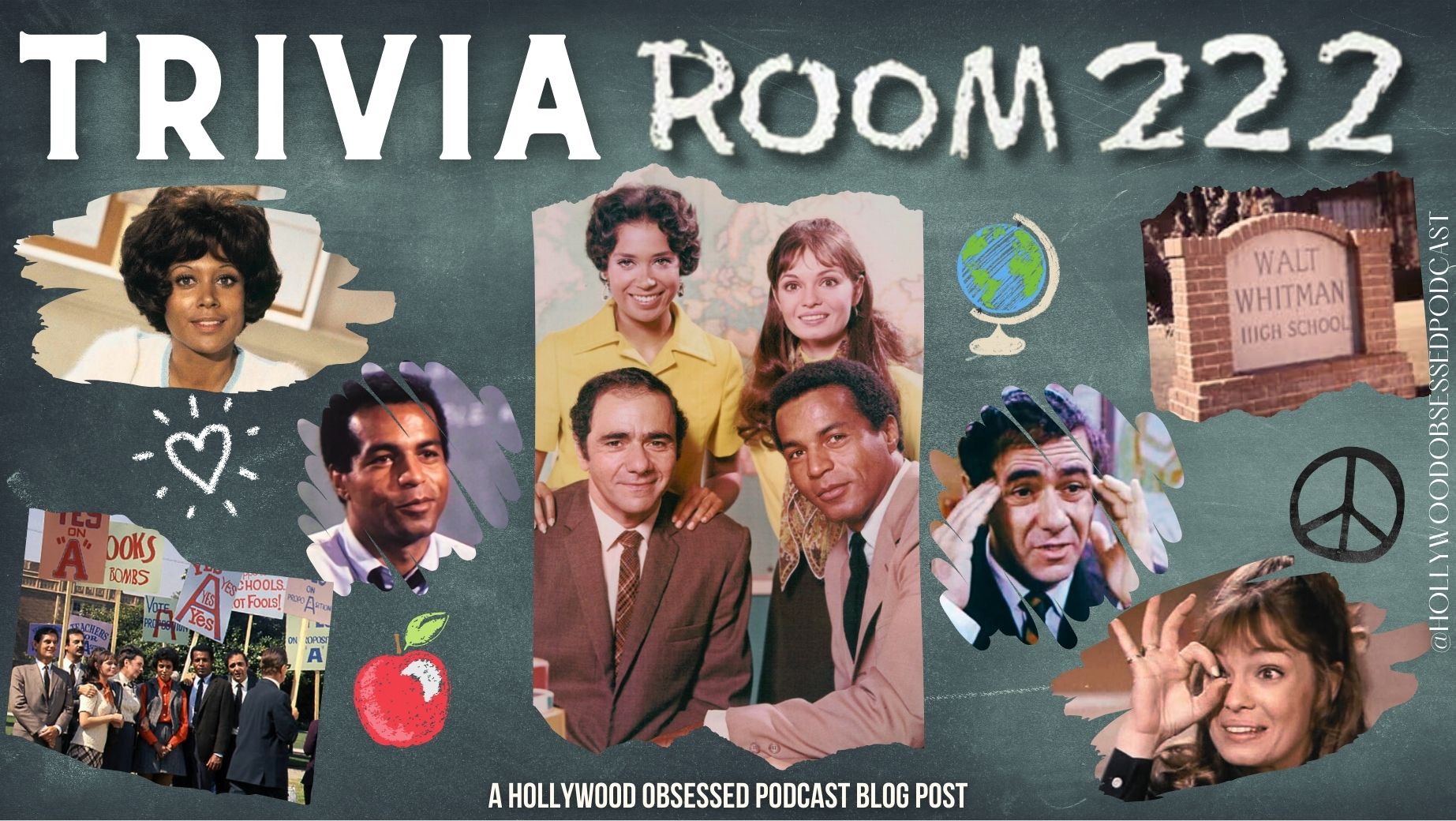
If you grew up glued to TV reruns the way I did, you know the thrill of discovering a show that felt different—smarter, warmer, and somehow more grown-up than the rest. For me, one of those shows was “Room 222.” I was probably too young to fully grasp the heavy social issues it bravely tackled, but I felt it. The school hallways, the compassionate teachers, the friendships, the lessons about acceptance, and the quiet triumphs over everyday hardships all left a lasting impression on my young, TV-loving brain.
Premiering in 1969, “Room 222” was groundbreaking television. Created by James L. Brooks and airing on ABC, the half-hour comedy-drama was set in an American history classroom at a racially integrated high school in Los Angeles—something rarely seen on television at the time. It became one of the first American series to thoughtfully explore real-world social issues like race, equality, and generational change, all while remaining heartfelt, funny, and deeply human.
Recently, I had the absolute joy of welcoming Denise Nicholas, who memorably portrayed guidance counselor Liz McIntyre, onto Hollywood Obsessed Podcast for an unforgettable two-part conversation (Episodes 157 & 158). Talking with Denise sent me straight back to those after-school reruns and that special feeling only classic television can give you.
So, in honor of that nostalgia-soaked trip down memory lane, I’ve gathered some fun trivia and behind-the-scenes gems from "Room 222." I hope these little tidbits spark the same smiles, memories, and warm fuzzy feelings they gave me. Class is in session—enjoy.
*************************************************
Room 222 was set at the fictional Walt Whitman High School, but its exterior shots came from the real Los Angeles High School. Tragically, the original building used for filming collapsed during the 1971 Sylmar earthquake, turning a TV landmark into a piece of lost history.
The series was one of the very first half-hour American television shows to seriously tackle contemporary social issues—an unheard-of move for network TV in the late 1960s.
The groundbreaking comedy-drama was created by James L. Brooks and produced by 20th Century Fox Television, laying the foundation for a whole new kind of storytelling on television.
The instantly recognizable theme song was composed by Jerry Goldsmith and written primarily in a 7/4 time signature, an unusually complex rhythm for a TV theme at the time.
The show featured a strong ensemble cast including Lloyd Haynes, Denise Nicholas, Michael Constantine, and Karen Valentine, each bringing depth and authenticity to their roles.
Room 222 was part of ABC’s legendary Friday night lineup, airing alongside The Brady Bunch, The Partridge Family, The Odd Couple, and Love, American Style.
The first six episodes of Season One included a laugh track, but starting with episode 1.7 (“Teacher’s Dropping Out,” 1969), it was permanently dropped to emphasize the show’s dramatic tone.
Karen Valentine portrayed the idealistic teacher Alice Johnson from 1969 to 1974. She won the Primetime Emmy Award for Outstanding Supporting Actress in a Comedy Series in 1970 and earned a Golden Globe nomination the following year.
Room 222 ran for a total of five seasons, leaving a lasting mark despite its relatively short run.
Michael Constantine earned critical acclaim as long-suffering principal Seymour Kaufman, winning the Primetime Emmy Award for Outstanding Supporting Actor in a Comedy Series in 1970, with additional Emmy and Golden Globe recognition the following year.
Throughout the entire series, history teacher Pete Dixon always had at least two familiar students in his classroom: Jason and Bernie.
Before being cast as guidance counselor Liz McIntyre, Denise Nicholas toured the Deep South for two years with the Free Southern Theater during the Civil Rights Movement. She later moved to New York City and joined the Negro Ensemble Company, appearing in every production of its first season.
The show stood out for its diverse, non-stereotypical cast, including African-American history teacher Pete Dixon and guidance counselor Liz McIntyre—rare and progressive portrayals for network television at the time.
A surprising number of future stars passed through the halls of Walt Whitman High, including Cindy Williams, Teri Garr, Jamie Farr, Rob Reiner, Michael Gray, Don Most, Angela Cartwright, Ed Begley Jr, Aretha Franklin, Richard Dreyfus, Chuck Norris, Tim Matheson, Larry Wilcox, Candy Clark, Audrey Landers, Kurt Russell, and Mark Hamill.
Early ratings were weak, and ABC nearly canceled the show after its first season. But multiple 1970 Emmy nominations changed everything. The series went on to win Best New Series, along with acting awards for Michael Constantine and Karen Valentine.
Karen Valentine was discovered by director Gene Reynolds, who noticed her fumbling during her audition and realized her awkwardness was actually comedy gold.
Many episodes tackled timely issues of the era, including the Vietnam War, women’s rights, race relations, and Watergate, making the show both socially aware and emotionally resonant.
Despite its topical edge, many storylines remain timeless. Episodes explored teen body image, anti-gay harassment, and parent-child conflict—issues still relevant to today’s students.
Ratings peaked during the 1971–72 season, when Room 222 ranked #28 in overall viewership.
The series serves as a vivid time capsule of late ’60s and early ’70s fashion, ideas, and social change—and helped pave the way for the dramedy genre that would dominate television in later decades.
A series of novels based on the show’s characters and dialogue were published in the early 1970s by Tempo Books, written by William Johnston.
Dell Comics also brought Room 222 to the page, publishing four comic book issues between 1970 and 1971.
By the 1973–74 season, ratings declined sharply, and ABC canceled the series mid-season. However, the show lived on in syndication, airing on stations across the U.S.
Room 222 was the first of three major franchises created or developed by James L. Brooks, followed by The Mary Tyler Moore Show and The Simpsons—arguably one of the most influential TV lineups in history.
Lead actor Lloyd Haynes, who portrayed Pete Dixon, died of lung cancer at age 52. His co-star Denise Nicholas attended his small, private funeral. During his illness, Haynes was also appearing on General Hospital as Mayor Ken Morgan.
The Television Academy Foundation has credited Room 222 with breaking ground in its portrayal of racially integrated classrooms and socially conscious storytelling—predating even Norman Lear’s iconic 1970s sitcoms like All in the Family and Maude.
Aretha Franklin guest-starred as Inez Jackson in the Room 222 episode “Where Is It Written?”, which originally aired on January 14, 1972. In a rare and memorable television appearance, the Queen of Soul performed alongside her backing group—an appearance that perfectly underscored the show’s socially conscious spirit and cultural relevance.
*************************************************
Some facts in this post were sourced from IMDb and Wikipedia.
More than 50 years later, “Room 222” stands as a powerful reminder of a moment when television began to change—when diversity, inclusion, and compassion finally started finding a place in American pop culture. Emerging from the turbulence of the 1960s, the series offered something quietly radical: hope. Hope that understanding could replace division. Hope that listening mattered. Hope that the next generation might do better than the last. Looking back now, there’s something especially moving about that optimism—perhaps because it feels so needed again today.
The world has changed, but the heart of “Room 222” hasn’t. The stories James L. Brooks created—and the characters he brought to life—still resonate because they were rooted in empathy, humanity, and the belief that progress was possible. Decades later, those lessons remain, living on in our memories and reminding us why this series mattered then… and still matters now.
If you’d like to revisit that extraordinary era, do yourself a favor and tune in to my in-depth, nostalgia-packed conversation with actress, writer, and trailblazing icon Denise Nicholas, best known for her groundbreaking roles on “Room 222” and “In the Heat of the Night.” Our two-part Hollywood Obsessed chat (Episodes 157 & 158) is a heartfelt, no-filter journey through a transformative time in American television—filled with humor, insight, and unforgettable behind-the-scenes stories.
Listen Now
Episode 157 – HERE
Episode 158 – HERE
Class dismissed… but the legacy lives on.

Growing up on the east coast, Tony's love for acting led him to take classes at the famous Herbert Berghof (HB) Studio in New York City. He then attended prep-school at Walnut Hill School of the Performing Arts in Natick, MA where he studied theater, dance, and voice.
Returning to New York for his final two years of high school, he appeared in several commercials, made his Off-Broadway debut in the Spanish-speaking play "The House with The Seven Balconies" (La Casa de Los Siete Balcones) alongside his mother, actress Gilda Mirós, and graduated from the Beekman School of New York.
Pursuing a theater degree, he studied at Whittier College in Southern California until he decided to give up acting and moved to Miami Beach - where he began a career in Public Relations. However, it wasn't until he started to write a nightlife column called "Beyond the Velvet Rope," for Miami Metro Magazine that he finally made a name for himself as a celebrated South Beach columnist and nocturnal personality known as "Mr. Nightlife." Since then, he has had a diverse writing career spanning 20 years and has written for national and international publications including Angeleno Magazine, ReFresh Magazine (UK), and TimeOut.
After moving to Los Angeles in 2005, he landed a job at the legendary Warner Bros Studios in Burbank as a VIP Tour Guide. After a successful yet brief stint there, he started a new career as a Casting Director at the Emmy Award-winning casting offices of Bunim-Murray Production in Van Nuys, CA where he worked …Read More
Trivia - Family