Trivia - Seven Brides For Seven Brothers (1954)
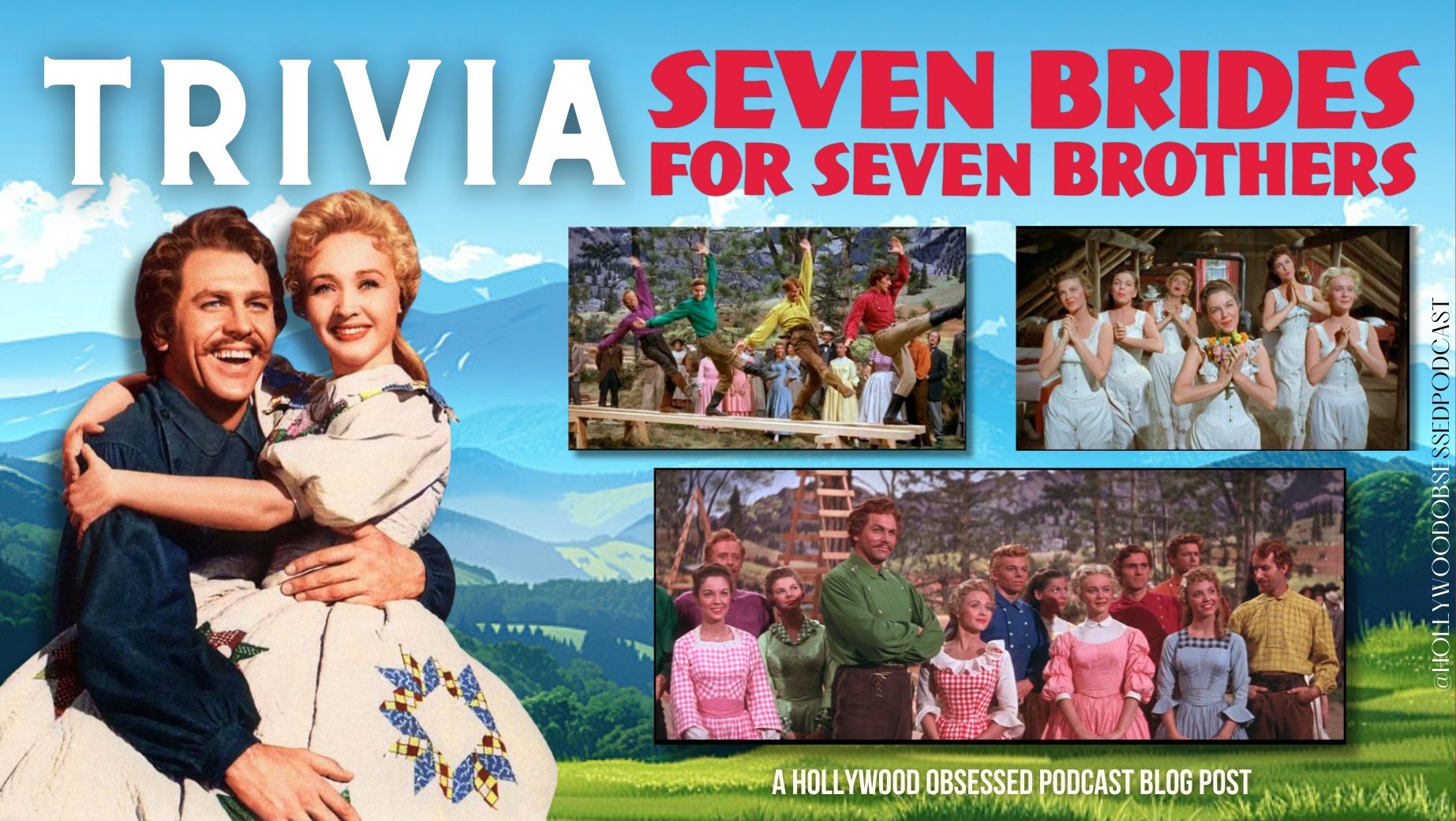
There is nothing—and I mean nothing—quite like an MGM musical. The sweeping backdrops! The lavish sets! The armies of dancers leaping across the screen in glorious Technicolor! Add in the glittering stars, the original songs, and the jaw-dropping choreography, and you’ve got pure cinematic magic every single time.
The 1950s were the crown jewel years of MGM’s musical empire, gifting us timeless masterpieces like "Singin’ in the Rain" and "An American in Paris." These weren’t just movies—they were morale-boosting, feel-good spectacles crafted to lift spirits during uncertain times. High production values, iconic performances, unforgettable tunes… it was Hollywood at its most dazzling.
So when someone claims MGM musicals were “just okay,” I kindly suggest they go get their heads examined. Case in point: "Seven Brides for Seven Brothers"—the 1954 Technicolor triumph directed by Stanley Donen, choreographed within an inch of perfection by Michael Kidd, and starring the irresistible duo Howard Keel and Jane Powell. Their tale of a spirited frontier bride taming her husband’s six unruly brothers is a whirlwind of comedy, romance, and barn-raising brilliance that’s more than earned its legendary status.
And now, inspired by my recent chat with the glamorous actress Ruta Lee—who charmed audiences as Ruth, one of the unforgettable “brides” (catch her on Hollywood Obsessed Episodes 147 & 148!)—I’ve put together a fun, nostalgic, and yes, slightly obsessive trivia list celebrating this award-winning classic.
Grab your dancing boots and enjoy the trip down memory lane!
*************************************************
The film was originally set to use the title of its source material, "The Sobbin’ Women," but MGM doubted audiences would embrace it. It was briefly changed to "A Bride for Seven Brothers," though censors found that too risqué. The final title, "Seven Brides for Seven Brothers," struck the right balance.
The story is based on Stephen Vincent Benét’s short story, itself inspired by the ancient Roman legend of the Rape of the Sabine Women.
Set in 1850s Oregon, the plot follows the seven Pontipee brothers—backwoodsmen who venture out to find wives of their own.
Producer Jack Cummings wanted Stanley Donen to direct from the start due to his successes with "On the Town" (1949) and "Singin’ in the Rain" (1952).
Choreographer Michael Kidd initially turned the film down after finishing a demanding Broadway show. He changed his mind once he heard the score. Donen assured him the brothers wouldn’t “dance”—only “stage” musical numbers—because Kidd doubted rugged mountain men would break into choreography. But when Donen later revealed the film needed extensive dancing, Kidd was furious.
The entire production was shot in just 48 days.
Because the film was made simultaneously in widescreen and standard ratio, scenes were filmed twice—widescreen in the morning, standard format in the afternoon.
To distinguish them from the town suitors, MGM decided all seven Pontipee brothers would be redheads.
The end credits cast list is divided into three groups: The Pontipee Brothers, The Brides, and The Townspeople.
Costume designer Walter Plunkett famously sourced old quilts from the Salvation Army and turned them into the brides’ dresses.
The dress colors worn by the six prospective brides during the barn-raising scenes are: Dorcas - mauve/white checked, Ruth --- blue, Martha --- green, Liza --- pink/white checked, Sarah --- yellow/white checked, and Alice --- salmon.
The shirt colors worn by Adam's six brothers during the barn-raising and final scenes are: Benjamin --- orange, Caleb --- yellow, Daniel --- purple, Ephraim --- light green, Frank - red, and Gideon --- blue. Adam wears an emerald green shirt.
Jeff Richards—formerly a professional baseball player—was one of two “brothers” not chosen for his dancing ability; the other was Howard Keel, cast for his acting and singing.
Lead actress Jane Powell, for whom the film was a career highlight, was born in Oregon approximately 70–80 years after the story’s setting.
Powell initially assumed co-star Jacques d’Amboise was French because he was so quiet; she later learned he was from New York and had a strong local accent.
This film marks the screen debut of Ruta Lee (Ruth).
George Chakiris revealed in his autobiography that he was originally offered the role of Gideon but chose instead to dance behind Rosemary Clooney in "White Christmas" (1954). His refusal led to Russ Tamblyn landing the role.
Julie Newmar, an accomplished dancer, was unable to showcase her full ability because her partner Jeff Richards lacked dance training.
Howard Keel called the film “one of my happiest filmmaking experiences at MGM,” praising its cast, chemistry, and Jane Powell’s performance. He later remarked, “A Seven Brides for Seven Brothers" doesn’t come along too often.”
MGM initially viewed the movie as a “B” production and funneled much of its budget into "Brigadoon" (1954). As a result, Donen had to rely heavily on painted backdrops instead of on-location shooting.
When Adam first visits town, four future brides appear at Bixby’s store: Ruth (bonnet with blue ribbons), Sarah (hat with black band), Liza (bonnet with pink ribbon), and Dorcas (hat with brown band).
The wood-chopping portion of the “Lonesome Polecat” number is performed in a single continuous take.
Despite MGM’s low financial expectations, the film ultimately outperformed "Rose Marie" (1954) and "Brigadoon" (1954), both of which the studio had prioritized.
Most of the film was shot on MGM sound stages, with one major exception: the kidnapping escape and avalanche sequences were filmed on location at Corral Creek Canyon in Sun Valley, Idaho.
In the “June Bride” number, Ruta Lee (Ruth) and Julie Newmar (Dorcas) were kept in the background—Lee due to limited dance experience, and Newmar because her height made pairing difficult.
The barn-raising dance required three weeks of rehearsal. During one session, Russ Tamblyn wandered in to observe and revealed his tumbling skills to choreographer Michael Kidd, who immediately incorporated acrobatics into Tamblyn’s choreography, ultimately transforming him into one of the film’s standout dancers.
Censors objected to the line “A man can’t sleep when he sleeps with sheep” in “Lonesome Polecat,” but the filmmakers kept it by ensuring no sheep appeared on screen.
Donen always lamented that MGM’s budget cuts prevented him from filming on location year-round to capture the changing seasons. He disliked the painted backdrops so much that he avoided watching the finished film for years.
Tensions occasionally flared between Howard Keel and Donen, at one point prompting Keel to try to have the director replaced with George Sidney.
Among all the brothers and brides, only Virginia Gibson sang her own vocals, making her the natural choice to lead “June Bride.” Others were dubbed; for example, Ruta Lee’s singing was performed by Betty Noyes.
Jacques d’Amboise had to leave early to honor his contract with the New York City Ballet, so a double filled in for him during the final days of filming. His absence is noticeable in the scene where the brothers pace downstairs while Milly gives birth.
Donen frequently credited Michael Kidd with the film’s immense success, saying, “His contribution to the film was gigantic.”
The movie premiered at Radio City Music Hall in the slot originally intended for "Brigadoon"—further proof that MGM had misjudged which 1954 musical would be the bigger hit.
The film became one of 1954’s biggest box-office successes, earning MGM over $3 million in profit (nearly $30 million in 2021 dollars).
"Seven Brides for Seven Brothers" won the Academy Award for Best Scoring of a Musical Picture and earned four additional nominations, including Best Picture.
Jane Powell and Howard Keel reprised their roles in a 1978 stage production.
The film inspired the television series "Here Come the Brides" (1968), which launched the careers of Bobby Sherman and David Soul.
Howard Keel passed away in November 2004, one month before the film’s induction into the National Film Registry.
With the death of Jacques d'Amboise (Ephraim) on May 3, 2021, Russ Tamblyn (Gideon) is the last surviving actor to play one of the brothers.
As of September 2025, Julie Newmar (Dorcas) and Ruta Lee (Ruth) are the last surviving brides.
*************************************************
Whether you’re a longtime fan of MGM musicals or you’re just now discovering their brilliance, there’s no denying the impact these types of films left an impression on all of us who has watched them. Especially Oscar winning ones like the 1954 classic "Seven Brides for Seven Brothers."
So do yourself a favor and listen to my in-depth, funny, warm, and downright fascinating conversation with actress Ruta Lee as she shares her favorite memories, behind-the-scenes gems, and insights that every MGM musical fan will love!
Listen to the full interview on Hollywood Obsessed Podcast!
Episode 147 - HERE
Episode 148 - HERE

THIRD YEAR ANNIVERSARY: Celebrating Three Fabulous Years of Hollywood Obsessed Podcast - Part 1