Trivia - St Elsewhere
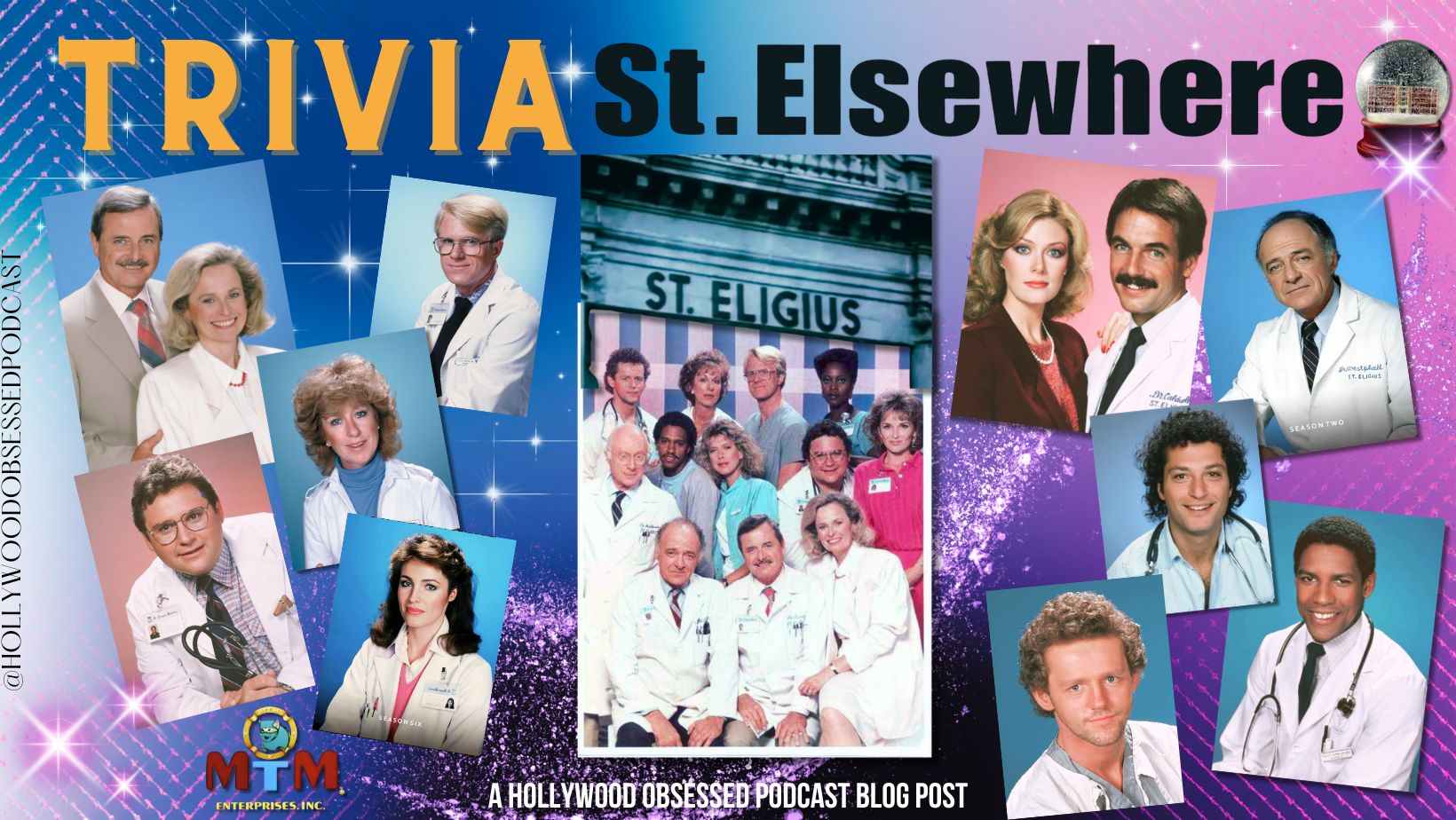
I don’t know about you, but I’ve always had a soft spot for medical TV shows. Maybe it started when I was a kid watching Jack Klugman solve medical mysteries on “Quincy, M.E..” Or perhaps it was those adrenaline-pumping reruns of “Emergency!.” But one thing is certain—by the 1980s my love for medical dramas was officially off the charts… and there was no cure for it once I discovered “St. Elsewhere.”
Widely praised for its gritty realism and complex storytelling, “St. Elsewhere” quickly developed a small but fiercely loyal following. Critics loved it too. During its six-season run, the series racked up 13 Emmy Awards for its writing, acting, and directing, and today it’s still widely considered one of the greatest television dramas ever produced. In TV-doctor terms, its legacy is in remarkably good health.
Set inside the fictional St. Eligius Hospital—a rundown teaching hospital in Boston’s South End—the series followed a group of brilliant but very human doctors trying to save lives while teaching young interns how to survive the emotional equivalent of a medical residency. With its large ensemble cast and layered storylines, critics often compared the show to “Hill Street Blues.” In fact, one early ad proudly quoted a critic who called it “Hill Street Blues in a hospital.” Not a bad diagnosis for greatness.
Like many loyal viewers, I was devastated when the show signed its discharge papers after six seasons, ending with one of the most talked-about—and unsettling—finales in television history on May 25, 1988. To say it left fans stunned would be an understatement. Let’s just say it gave television viewers one of the most surprising “chart notes” ever written.
So when I recently had the opportunity to sit down with one of the show’s biggest stars—the beloved television icon and two-time Emmy Award winner Bonnie Bartlett Daniels, forever remembered as the formidable Ellen Craig—II had to check my pulse because my heart was beating a little too fast.
After our wonderful two-part conversation on Episodes 161 & 162 of Hollywood Obsessed, I did what any devoted fan would do: I scrubbed in and assembled this fun collection of “St. Elsewhere“ trivia.
So grab your scrubs and your stethoscope—because we’re about to make a house call back to one of the most groundbreaking medical dramas ever made, the show that helped pave the way for hits like “ER” and “The Pitt.”
Enjoy—doctor’s orders!
*************************************************
St. Eligius, the name of the hospital in the show, is the patron saint of veterinarians, sick horses, metalsmiths, and cab drivers.
The setting was based on Boston City Hospital (now Boston Medical Center) in Boston’s South End.
The series was created by Joshua Brand and John Falsey. It originally ran on NBC from October 26, 1982, to May 25, 1988.
The series was produced by MTM Enterprises, which also had success with the NBC police drama “Hill Street Blues” during the same period.
The show’s main and end-title theme was composed by famed jazz musician and composer Dave Grusin.
“St. Elsewhere” was a nickname for the fictional, rundown St. Eligius Hospital in Boston, used because it was considered a "dumping ground" for patients unwanted by prestigious hospitals. It implied the hospital was a place to send patients "elsewhere", highlighting the staff’s struggle in a low-status institution.
The show was known for its inside jokes. Writers named characters after staff members and often included references to other TV shows, movies, plays, and books.
Before Ed Flanders was cast as Dr. Donald Westphall, Hal Linden was offered the role but turned it down.
At the beginning of many episodes, the exact time the story was taking place briefly appeared in the corner of the screen.
The show never achieved high ratings but lasted six seasons on NBC because it appealed strongly to the desirable advertiser demographic of educated viewers ages 18–49.
William Daniels (Dr. Mark Craig) and Bonnie Bartlett Daniels (Ellen Craig) are married in real life.
The orderly Warren “Cool” Coolidge was played by the same actor who portrayed the character in “The White Shadow”. In one episode he is seen wearing his Carver High School varsity letter. In another episode, when an actor from “The White Shadow” appeared in a different role, he was mistakenly referred to by his character’s name from that series—and corrected the “mistake” on camera.
The show was sued by Humana over similarities between the company and “Ecumena,” the corporation that took over St. Eligius in the series. The show eventually dropped the name and added a disclaimer to each episode.
William Daniels said that when he was offered the role of Dr. Mark Craig, producers gave him not only the pilot script but also the first three scripts to read. They wanted him to understand that his character would sometimes be central to the story and sometimes not, emphasizing the show’s ensemble nature.
At the end of each episode, the MTM kitty logo appears wearing a surgeon’s cap and mask. In the final episode’s end credits, the MTM kitty is shown lying in a hospital bed with the plug pulled. The real MTM cat reportedly died about two months after the series ended.
The elevated train seen in the opening titles is Boston’s Orange Line of the Massachusetts Bay Transportation Authority. During the final season, the line moved underground and no longer ran on elevated tracks, making the opening footage technically outdated.
Notable guest stars included Tim Robbins, whose first major role was in the first three episodes as domestic terrorist Andrew Reinhardt. Doris Roberts and James Coco each won Emmy Awards for their Season 1 appearances as a homeless woman and her mentally challenged husband.
Friends and family members of the cast and crew often provided the names of doctors paged over the hospital PA system. In several episodes, “Dr. Gwyneth Paltrow” is paged—a nod to executive producer Bruce Paltrow, her father.
According to actor G. W. Bailey (Dr. Hugh Beale), he left the series after the first season because he did not get along with executive producer Bruce Paltrow.
Norman Lloyd was cast as Dr. Daniel Auschlander partly because of his lifelong friendship with Bruce Paltrow’s family. Originally intended to appear in only four episodes, he remained with the series until its conclusion.
Ed Flanders reportedly had conflicts with co-stars, combined with drinking problems, which led to his departure at the end of Season 5. He returned for the first two episodes of the final season and the series finale.
The Season 3 finale ended with Drs. Westphall, Auschlander, and Craig visiting the famous bar from “Cheers,” which was also set in Boston. Earlier, during Season 2 of “Cheers,” barmaid Carla Tortelli (Rhea Perlman) gave birth at St. Eligius and later complained about her treatment there, even arguing with Dr. Craig. The crossover scene was filmed on the “Cheers” soundstage at Paramount Studios.
The hospital facade used for St. Eligius is Franklin House on East Newton Street in Boston. The building provides affordable housing for South End residents today. From the early 1900s to the 1970s, it was the Franklin Square Hotel for Women, offering apartments for young working women. Faye Dunaway briefly lived there after graduating from Boston University.
Before joining the series as Dr. Victor Ehrlich and Dr. Wayne Fiscus, Ed Begley Jr. and Howie Mandel were longtime fans of William Daniels.
Bonnie Bartlett Daniels and Ed Flanders previously played husband and wife in “The Legend of Lizzie Borden” and “Salem's Lot.”
Because of the show’s large ensemble cast and demanding production schedule, Norman Lloyd could not appear in every episode, even after becoming a regular in Season 2.
Ironically, Denzel Washington was actually a pre-med student in college, which helped prepare him for his role as Dr. Phillip Chandler.
Although the series ran for six seasons, only about three years passed within the show’s storyline.
The series helped launch the careers of Ed Begley Jr., Howie Mandel, David Morse, Denzel Washington, Mark Harmon, Chad Allen, Stephen Furst, Sagan Lewis, Jennifer Savidge, and Terence Knox.
Despite critical acclaim, the series ended after six seasons due to economic pressures. Production costs were higher than what NBC paid to broadcast the show, and the outlook for recouping those costs through syndication was uncertain.
When Mark Harmon wanted to leave the show, his character, plastic surgeon Dr. Bobby Caldwell, exited after contracting AIDS—one of television’s earliest storylines dealing with the disease. During Dr. Caldwell’s memorial service, Nurse Rosenthal remarks that Caldwell always thought he was “the sexiest man alive,” a reference to Mark Harmon being named People magazine’s Sexiest Man Alive in 1986.
Bonnie Bartlett and husband William Daniels made Emmy Awards history in 1986 when they became the second real-life married couple to win acting awards on the same night. Alfred Lunt and Lynn Fontanne first accomplished the feat in 1965.
Ed Begley Jr. originally auditioned for Dr. Peter White but was cast instead as Dr. Victor Ehrlich. The role of Dr. White ultimately went to Terence Knox.
William Daniels personally suggested casting his real-life wife Bonnie Bartlett Daniels as Ellen Craig. She was initially hesitant, but Daniels thought it would be amusing to play married on screen as well.
The series featured one of the first dramatic television storylines about breast cancer. Writers Tom Fontana and actress Christina Pickles conducted extensive research for the storyline.
Actor David Paymer originally played Dr. Wayne Fiscus in the pilot but was replaced by comedian Howie Mandel, marking Mandel’s first—and only—dramatic television role.
The series earned 62 Primetime Emmy Award nominations, winning 13. Among the winners were Ed Flanders and William Daniels for Outstanding Lead Actor in a Drama Series, while Bonnie Bartlett Daniels and Doris Roberts won for Supporting Actress, and James Coco won for Supporting Actor.
The final scene of the series finale featured one of the most unexpected twists in television history. The concept echoed the famous ending of another MTM series, "Newhart."
Ed Begley Jr., William Daniels, Stephen Furst, and Eric Laneuville later reunited for a Season 1 episode of “Scrubs.” Rather than reprising their “St. Elsewhere” roles, they played a group of doctors who fall ill at a medical convention. The episode was part of NBC’s 75th Anniversary celebration.
In her memoir, Middle of the Rainbow, Bonnie Bartlett opened up about the couple's early struggles, including a period of having an open marriage and dealing with infidelity, which they later overcame to strengthen their bond.
*************************************************
Some facts in this post were sourced from IMDb and Wikipedia—because even the most dedicated TV fans occasionally need to consult the medical charts.
If you’d like to hear even more about this award-winning classic series, be sure to check out my fascinating conversation with Ellen Craig herself, the wonderfully talented Bonnie Bartlett Daniels.
Our two-part Hollywood Obsessed chat (Episodes 161 & 162) is a heartfelt, no-filter journey filled with humor, insight, and unforgettable behind-the-scenes Hollywood stories—exactly what the doctor ordered…
So grab your headphones, check your pulse, and scrub in for one of the most delightful conversations you’ll hear all week.
Listen now:
Episode 161 – HERE
Episode 162 – HERE

Growing up on the east coast, Tony's love for acting led him to take classes at the famous Herbert Berghof (HB) Studio in New York City. He then attended prep-school at Walnut Hill School of the Performing Arts in Natick, MA where he studied theater, dance, and voice.
Returning to New York for his final two years of high school, he appeared in several commercials, made his Off-Broadway debut in the Spanish-speaking play "The House with The Seven Balconies" (La Casa de Los Siete Balcones) alongside his mother, actress Gilda Mirós, and graduated from the Beekman School of New York.
Pursuing a theater degree, he studied at Whittier College in Southern California until he decided to give up acting and moved to Miami Beach - where he began a career in Public Relations. However, it wasn't until he started to write a nightlife column called "Beyond the Velvet Rope," for Miami Metro Magazine that he finally made a name for himself as a celebrated South Beach columnist and nocturnal personality known as "Mr. Nightlife." Since then, he has had a diverse writing career spanning 20 years and has written for national and international publications including Angeleno Magazine, ReFresh Magazine (UK), and TimeOut.
After moving to Los Angeles in 2005, he landed a job at the legendary Warner Bros Studios in Burbank as a VIP Tour Guide. After a successful yet brief stint there, he started a new career as a Casting Director at the Emmy Award-winning casting offices of Bunim-Murray Production in Van Nuys, CA where he worked …Read More

THIRD YEAR ANNIVERSARY: Celebrating Three Fabulous Years of Hollywood Obsessed Podcast - Part 1