The Fabulous Films of Paul Rudnick

Happy Pride Month! To celebrate, I'm spotlighting one of the funniest, smartest, and most influential storytellers in entertainment—my latest Hollywood Obsessed Podcast guest, Paul Rudnick. If the name doesn't immediately sound familiar, chances are you've laughed at, quoted, or been touched by something he's written. Paul is the acclaimed novelist, playwright, essayist, and screenwriter behind beloved films such as “Addams Family Values,” “In & Out,” “Jeffrey,” and “Isn't She Great.”
Born and raised in Piscataway, New Jersey, and a graduate of Yale University, Paul moved to New York City to pursue a career as a playwright. He went on to create a remarkable body of stage work, including “I Hate Hamlet,” “Regrets Only,” “The New Century,” and the groundbreaking AIDS-era comedy “Jeffrey,” which helped establish him as one of the most original and fearless voices in American theater.
Beyond the stage, Paul became one of Hollywood's most sought-after screenwriters and script doctors, contributing to films such as “The Addams Family,” “The First Wives Club,” and “The Devil Wears Prada.” In Hollywood Obsessed Podcast Episodes 173 and 174, he shares hilarious and revealing behind-the-scenes stories from the making of “In & Out,” “Addams Family Values,” and “Jeffrey,” while offering fascinating insight into the art of screenwriting, script rewrites, and creative collaboration.
Along the way, Paul recalls memorable experiences working with an incredible roster of talent, including Patrick Stewart, Nathan Lane, Tom Selleck, Christine Baranski, Linda Lavin, and Anjelica Huston. He also discusses his brand-new novel, “The Tuxedo Society,” a witty, stylish, and action-packed LGBTQ+ espionage thriller that is already delighting readers around the world.
It was a genuine thrill to sit down with Paul and explore his extraordinary career. Whether you're a fan of his films, plays, books, or simply love great Hollywood stories, these two episodes are packed with laughter, nostalgia, and fascinating insider tales. I hope this look back at Paul Rudnick's fabulous films inspires you to revisit his work—and then tune in to Episodes 173 and 174 of Hollywood Obsessed Podcast. Enjoy!
*************************************************
JEFFREY (1995)
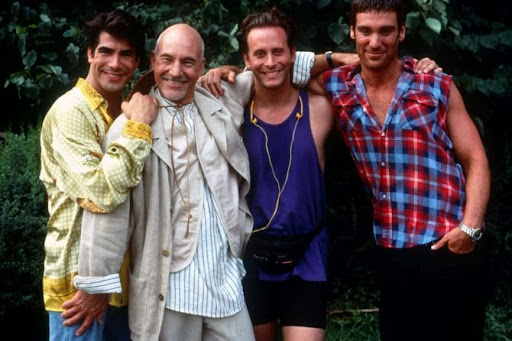
If I had to pick a favorite Paul Rudnick film, “Jeffrey” would be near the top of the list. Directed by Christopher Ashley and adapted by Rudnick from his own acclaimed Off-Broadway play, this witty, heartfelt, and surprisingly moving romantic comedy remains one of the most unique films of the 1990s.
Set in Manhattan during the height of the AIDS epidemic, “Jeffrey” follows a neurotic, lovable actor and waiter who decides that the safest way to avoid heartbreak is to give up sex—and relationships altogether. It's not death that terrifies Jeffrey; it's the possibility of falling deeply in love with someone he might lose. Naturally, life has other plans. Almost immediately after taking his vow of celibacy, he meets Steve, a handsome, intelligent, and charming HIV-positive man who turns Jeffrey's carefully constructed world upside down. What follows is a funny, touching, and deeply human journey as Jeffrey struggles to overcome his fears and open himself to the possibility of love.
Leading the cast are Steven Weber as the anxious but endearing Jeffrey and Michael T. Weiss as the irresistible Steve. The film is elevated even further by Patrick Stewart's scene-stealing performance as Sterling, Jeffrey's flamboyant and fiercely loyal interior designer friend, and Bryan Batt as Sterling's sweet younger partner, Darius. Rudnick also packed the film with memorable cameos, including Nathan Lane as the wonderfully eccentric Father Dan, Sigourney Weaver as a hilariously over-the-top self-help guru, and Christine Baranski in one of several delightful supporting turns.
What makes “Jeffrey” so remarkable is its tone. Released during a period when AIDS was still devastating communities around the world, the film boldly chose to confront the crisis with humor, compassion, and optimism. Rudnick never minimizes the tragedy of the epidemic, but he also refuses to let fear have the final word. Instead, he celebrates friendship, resilience, romance, and the strength of the LGBTQ+ community.
While some critics at the time felt the film's theatrical roots occasionally showed, “Jeffrey” has endured as a beloved cult classic. More than thirty years later, its message remains as powerful as ever: love is always worth the risk. Funny, fearless, and deeply life-affirming, “Jeffrey” stands as one of Paul Rudnick's finest achievements and a shining example of how comedy can help us navigate even the most difficult chapters of life.

IN & OUT (1997)
One of Paul Rudnick's biggest mainstream successes, “In & Out” is a charming, clever, and groundbreaking comedy that helped bring LGBTQ+ themes to multiplex audiences at a time when Hollywood rarely did so. Directed by Frank Oz, the film expertly blends sharp satire, romantic comedy, and heartfelt storytelling, creating an entertaining crowd-pleaser that remains surprisingly fresh nearly three decades later.
The story centers on Howard Brackett, a beloved high school English teacher in a small Indiana town who is just days away from marrying his longtime fiancée, Emily Montgomery. Howard's carefully ordered life is thrown into chaos when Cameron Drake, a former student turned Oscar-winning movie star, unexpectedly thanks his old teacher during a nationally televised acceptance speech—and casually reveals that Howard is gay. Suddenly, Howard finds himself at the center of a media frenzy, forcing him to confront questions about his identity that he has spent years avoiding.
Kevin Kline delivers one of the finest performances of his career as the bewildered and deeply conflicted Howard, while Joan Cusack nearly steals the film as his increasingly frantic fiancée. Her hilarious and heartbreaking performance earned her an Academy Award nomination for Best Supporting Actress. The stellar ensemble cast also includes Tom Selleck as Peter Malloy, the openly gay television journalist who develops an unexpected connection with Howard; Matt Dillon as the well-meaning movie star whose public remarks ignite the controversy; Debbie Reynolds as Howard's loving and supportive mother; Wilford Brimley as his traditional father; and Bob Newhart as the perpetually anxious school principal.
One of the film's most fascinating origins is that Rudnick drew inspiration from Tom Hanks' 1994 Academy Award acceptance speech for “Philadelphia.” During the speech, Hanks paid tribute to his high school drama teacher and a former classmate, referring to them as "two of the finest gay Americans." Rudnick took that real-life moment and imagined what might happen if someone were publicly identified in such a way without expecting it. The result was a smart and compassionate comedy that explored acceptance, identity, and the pressures of conformity in small-town America.
“In & Out” also made headlines for featuring a brief but much-discussed kiss between Kevin Kline and Tom Selleck—a rare sight in a mainstream PG-13 studio comedy at the time. While that moment generated media attention, the film's lasting legacy lies in its warmth and humanity. Beneath the laughs, Paul Rudnick crafted a story about self-discovery, honesty, and the importance of embracing who you are. The film was both a critical and commercial success, earned a GLAAD Media Award for Outstanding Film, and remains one of the most significant—and funniest—comedies of the 1990s.

ADDAMS FAMILY VALUES (1993)
If there is one film that perfectly captures Paul Rudnick's wicked sense of humor and gift for social satire, it's “Addams Family Values”. Directed by Barry Sonnenfeld, this deliciously dark comedy is not only one of Rudnick's finest screenplays, but also one of the rare sequels that many fans and critics consider superior to the original. Packed with unforgettable characters, razor-sharp dialogue, and some of the funniest one-liners of the 1990s, the film remains a comedy classic more than three decades after its release.
The story finds Gomez and Morticia Addams welcoming a new baby boy, the mustachioed Pubert Addams, much to the horror of his older siblings. Convinced that the arrival of a new child means one of them must be eliminated, Wednesday and Pugsley launch a series of hilariously disastrous attempts to dispose of their infant brother. Meanwhile, Uncle Fester falls head over heels for Debbie Jellinsky, a beautiful nanny who appears perfect on the surface but is secretly a manipulative black widow with a deadly history and her eye on the Addams fortune.
The cast is nothing short of spectacular. Anjelica Huston and Raúl Juliá are once again magnificent as the passionately devoted Morticia and Gomez, while Christopher Lloyd brings enormous heart and comic vulnerability to Uncle Fester. Christina Ricci delivers a star-making performance as Wednesday Addams, transforming the character into a cultural icon with her pitch-perfect deadpan delivery and razor-sharp sarcasm. Then there is Joan Cusack, who nearly steals the entire movie as Debbie Jellinsky. Her gleefully unhinged performance as the homicidal nanny is one of the great comedic villain turns in modern film history, earning her a Golden Globe nomination and the lasting admiration of movie fans everywhere.
Among the film's many highlights is Wednesday's legendary Thanksgiving pageant rebellion at Camp Chippewa. Forced to participate in a painfully sanitized reenactment of the first Thanksgiving, Wednesday unleashes a blistering and hilarious takedown of American historical mythology that remains one of the most quoted and celebrated scenes in the entire Addams Family franchise. Equally memorable is Fester's doomed romance with Debbie, which provides some of the film's biggest laughs while showcasing Rudnick's talent for blending absurd comedy with genuine affection for his characters.
What makes “Addams Family Values” so brilliant is that beneath the gothic costumes and macabre jokes lies a surprisingly sharp commentary on American culture. In Rudnick's world, the Addams family—who embrace individuality, honesty, and unconditional love—are actually the most emotionally healthy people in the movie. By contrast, the relentlessly cheerful "normal" world around them is often shallow, judgmental, and absurd. The screenplay is packed with endlessly quotable dialogue, it's comedy gold. Dark, daring, and endlessly funny, “Addams Family Values” stands as one of Paul Rudnick's crowning achievements and one of the smartest studio comedies ever made.

SISTER ACT (1992)
One of the most fascinating chapters in Paul Rudnick's Hollywood career involves a movie he is closely associated with—but for which he isn't even credited. “Sister Act” became one of the biggest box-office hits of 1992, launched a beloved franchise, and remains a fan favorite more than thirty years later. Yet behind the film's enormous success lies one of Hollywood's most legendary stories of creative conflict, rewrites, and development hell.
The project began as an original idea from Rudnick in the late 1980s. Inspired by classic disguise comedies such as “Some Like It Hot,” he imagined a female equivalent in which a worldly nightclub performer hides out in a convent. Rudnick envisioned the film as a sharp, satirical, and decidedly adult comedy—a collision between show business and organized religion that he jokingly described as "pop versus pope." The lead character, originally named Terri Van Cartier, was written specifically for Bette Midler, with whom Rudnick hoped to create a star vehicle packed with his trademark wit and irreverence.
Everything changed when Bette Midler declined the role, concerned that audiences might not embrace her playing a nun. When Whoopi Goldberg came aboard, the studio shifted its vision dramatically. Disney wanted a broad, family-friendly PG comedy rather than Rudnick's edgy satire. Multiple writers were brought in to revise the screenplay, including the secretly recruited Carrie Fisher, who was asked to help reshape Goldberg's dialogue. As draft after draft moved further away from Rudnick's original concept, he watched the film evolve into something almost entirely different from the screenplay he had created.
By the time “Sister Act” reached theaters, Rudnick felt so disconnected from the final product that he requested his name be removed from the credits altogether. In its place appeared the pseudonym "Joseph Howard," a fictional name that remains credited on both Sister Act and its sequel. Ironically, despite his frustration with the final film, “Sister Act” became a cultural phenomenon, grossing hundreds of millions of dollars worldwide and inspiring sequels, stage adaptations, and generations of devoted fans. It stands as a perfect example of one of Hollywood's great contradictions: a movie can become a beloved classic while bearing only a faint resemblance to the writer's original vision. For Paul Rudnick, “Sister Act” remains both a remarkable success story and one of the most famous "what might have been" tales in modern screenwriting history.

COASTAL ELITES (2020)
Few projects better demonstrate Paul Rudnick's ability to adapt to changing times than "Coastal Elites,” the sharp, funny, and surprisingly moving HBO comedy that emerged from one of the most chaotic periods in modern history. Written by Rudnick and directed by Jay Roach, the film began life as a live theatrical production scheduled to premiere at New York's Public Theater in 2020. Then the COVID-19 pandemic shut down theaters across the country almost overnight. Rather than abandon the project, Rudnick and his collaborators transformed it into one of the most ambitious and inventive quarantine productions ever attempted.
The film features an extraordinary ensemble cast, including Bette Midler, Dan Levy, Issa Rae, Sarah Paulson, and Kaitlyn Dever, each portraying a different character through a series of standalone monologues. The format proved unexpectedly perfect for the moment. Since the original play was already structured around five deeply personal monologues, the material naturally lent itself to the intimate, direct-to-camera style that audiences had become accustomed to during lockdown. Rudnick further revised the script to reflect the rapidly changing realities of 2020, weaving the pandemic and the nationwide Black Lives Matter protests directly into the lives and experiences of his characters.
What happened behind the scenes was almost as fascinating as what appeared on screen. Filming a professional HBO production during quarantine required an extraordinary level of creativity. Small technical crews would enter each actor's home or guest house to install professional cameras, lighting equipment, and microphones. Once everything was in place, the spaces were thoroughly sanitized and the crew departed completely. Only then would the actor return to perform. Director Jay Roach and Rudnick supervised the shoots remotely from their own homes, communicating through Zoom, video monitors, and walkie-talkies.
With no traditional crew members or scene partners present during filming, family members often stepped in to help. Bette Midler's husband and Kaitlyn Dever's father served as impromptu production assistants, helping manage equipment and logistics. The actors faced an equally daunting challenge. Because the film relied almost entirely on extended monologues, performers such as Dan Levy, Sarah Paulson, Issa Rae, and Midler had to memorize lengthy 15-to-20-minute speeches and deliver them directly into the camera, often in a single uninterrupted take. The result is remarkably intimate, creating the feeling that each character is speaking directly to the audience.
What makes “Coastal Elites” so memorable is that it serves as both a time capsule and a showcase for Rudnick's trademark wit. While the film offers plenty of laughs and biting political satire, it also captures the anxiety, isolation, uncertainty, and resilience that defined 2020 for millions of people. Through humor, compassion, and sharp social observation, Paul Rudnick transformed a moment of unprecedented disruption into an engaging and uniquely creative piece of entertainment. In many ways, “Coastal Elites” stands as a testament not only to his talent as a writer, but also to the ingenuity of artists determined to keep telling stories when the world seemed to come to a standstill.
ISN'T SHE GREAT (2000)
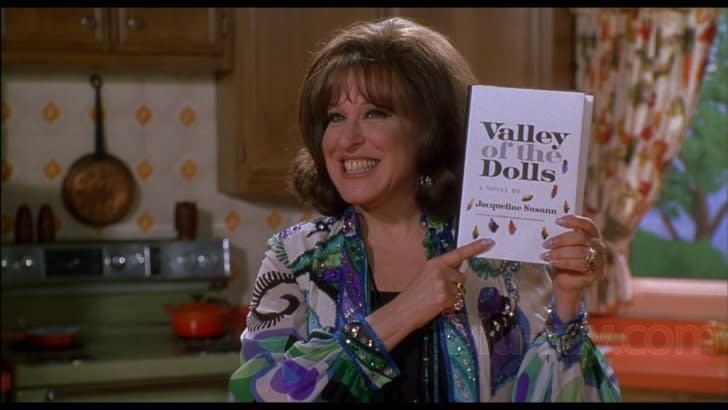
Of all the films in Paul Rudnick's career, “Isn't She Great” may be the one that feels most tailor-made for his unique sensibilities. A colorful, outrageous, and unapologetically campy celebration of literary celebrity, the film stars Bette Midler as bestselling author Jacqueline Susann, the woman who shocked the publishing world with “Valley of the Dolls” and transformed herself into one of the first true media-savvy authors. Written by Rudnick and directed by Andrew Bergman, the film embraces the larger-than-life spirit of its subject with the same irreverent humor that has become one of the writer's trademarks.
Rather than aiming for strict historical accuracy, “Isn't She Great” presents a highly stylized and often wildly exaggerated portrait of Susann's rise from struggling actress to publishing phenomenon. After years of chasing an acting career with little success, Jackie reinvents herself as a novelist with the unwavering support of her devoted husband and press agent, Irving Mansfield, played by the marvelous Nathan Lane. Together they revolutionize book promotion, traveling across America and turning Jackie into a literary superstar. Their efforts culminate in the publication of “Valley of the Dolls,” the scandalous bestseller that became a cultural sensation and one of the most successful novels of its era.
Midler throws herself into the role with infectious energy, capturing Susann's relentless ambition, insecurity, and larger-than-life personality. Lane provides the perfect comic and emotional counterbalance as Irving Mansfield, whose unwavering loyalty becomes the heart of the film. The supporting cast is equally impressive, featuring Stockard Channing, David Hyde Pierce, John Cleese, and Amanda Peet, all of whom fully embrace the film's broad comedic style and colorful world.
Beneath the glamorous costumes, sparkling dialogue, and outrageous humor lies a surprisingly poignant story. The film touches on several of Susann's personal struggles, including her battle with breast cancer and the heartbreaking challenges surrounding her autistic son. While these elements are filtered through the movie's heightened, often cartoonish tone, they provide moments of genuine humanity amid the comedy. Rudnick balances the absurdity of celebrity culture with an affection for outsiders, dreamers, and ambitious people determined to succeed on their own terms.
Although critics were divided upon its release and the film struggled at the box office, “Isn't She Great” has gradually earned a loyal cult following. Fans of camp cinema continue to celebrate its vibrant visual style, rapid-fire wit, and the irresistible chemistry between Midler and Lane. More than anything, the film feels like a perfect marriage of subject and screenwriter. Jacqueline Susann was bold, controversial, funny, and impossible to ignore—qualities that Paul Rudnick clearly admired and skillfully brought to life. Whether viewed as a comedy, a show-business satire, or a love letter to one of publishing's most unforgettable personalities, “Isn't She Great” remains one of the most entertainingly eccentric entries in Rudnick's filmography.

THE STEPFORD WIVES (2004)
Few films in Paul Rudnick's career are as fascinating—or as controversial—as “The Stepford Wives.” Directed by Frank Oz and starring Nicole Kidman, Bette Midler, Matthew Broderick, Christopher Walken, and Glenn Close, the 2004 remake took Ira Levin's chilling 1972 novel and transformed it into something entirely different: a glossy, campy, science-fiction black comedy packed with satire, celebrity star power, and Rudnick's signature razor-sharp wit.
Rather than simply retelling the original story, Rudnick completely reimagined the premise for the 21st century. In his version, the women of Stepford are no longer anonymous suburban housewives. They are successful executives, television personalities, entrepreneurs, and career-driven professionals who suddenly find themselves transformed into impossibly perfect domestic goddesses. Beneath the comedy, Rudnick was taking aim at the cultural backlash against ambitious women, questioning why society still seemed uncomfortable with female power and independence. He also expanded the story's social commentary by introducing a gay couple into the narrative, broadening the film's examination of conformity and society's obsession with "normality."
The cast was a dream lineup of comedic and dramatic talent. Nicole Kidman stars as Joanna Eberhart, a successful television executive whose life unravels after she relocates to the seemingly perfect town of Stepford. Bette Midler provides many of the film's biggest laughs as Joanna's outspoken best friend Bobbie Markowitz, while Matthew Broderick plays Joanna's husband Walter. Christopher Walken brings his trademark eccentricity to the mysterious leader of the Stepford Men's Association, and Glenn Close delivers a memorable performance as Claire Wellington, the town's unnervingly cheerful queen bee.
Unfortunately, the story behind the camera proved almost as dramatic as the one on screen. The production became infamous for extensive rewrites, shifting creative directions, and reported conflicts among key members of the cast and crew. As the screenplay evolved during filming, different versions of the story competed for dominance. The constant revisions created enormous challenges for everyone involved and contributed to a production that ran significantly longer than originally planned.
While “The Stepford Wives” received mixed reviews upon release and never fully achieved the satirical bite Rudnick originally envisioned, the film has become an intriguing curiosity within his body of work. Beneath its uneven execution lies a clever premise and many flashes of Rudnick's trademark humor, particularly in its commentary on gender roles, perfectionism, and cultural conformity. Today, the film remains a fascinating "what if?" in his filmography—a bold attempt to update a classic feminist thriller for a new generation, even if the turbulent production ultimately overshadowed much of its ambition. For fans of Paul Rudnick, “The Stepford Wives” offers a glimpse of a writer determined to challenge convention, even when Hollywood itself proved to be the biggest obstacle.
*************************************************
Some facts featured in this article were sourced from IMDb and Wikipedia.
Celebrate Pride Month by revisiting any of these fabulous films from Paul Rudnick, a writer whose wit, heart, and originality have entertained audiences for decades. Whether you're in the mood for big laughs, memorable characters, sharp social satire, or uplifting stories about love, acceptance, and individuality, these movies offer the perfect excuse to enjoy the work of one of Hollywood's most distinctive and beloved storytellers.
If this look back at Paul's remarkable filmography has left you wanting more, be sure to listen to my in-depth conversation with him on Hollywood Obsessed Podcast Episodes 173 and 174. Our wide-ranging discussion is packed with hilarious behind-the-scenes stories, fascinating Hollywood history, candid insights into the screenwriting process, and wonderful memories from the making of some of his most beloved films. These episodes are a must-listen for movie lovers, writers, cinephiles, and pop culture fans alike.
Listen here:
Episode 173 — HERE
Episode 174 — HERE

Growing up on the East Coast, Tony Miros developed a passion for acting at an early age, studying at New York City’s renowned Herbert Berghof (HB) Studio. He later attended Walnut Hill School for the Performing Arts in Natick, Massachusetts, where he trained in theater, dance, and voice.
Returning to New York to complete high school at The Beekman School, Tony began working professionally, appearing in commercials and making his Off-Broadway debut in "The House with the Seven Balconies" (La Casa de los Siete Balcones) alongside his mother, acclaimed actress and radio talk show host Gilda Mirós.
Tony continued his theater studies at Whittier College in Southern California before pivoting away from acting and relocating to Miami Beach, where he launched a successful career in public relations. It was there that he found his distinctive voice as a writer, creating the popular nightlife column "Beyond the Velvet Rope" for Miami Metro Magazine. The column established him as a celebrated South Beach personality, earning him the moniker “Mr. Nightlife.” Over the past two decades, Tony has built a diverse writing career, contributing to national and international publications including Angeleno Magazine, ReFresh Magazine (UK), and Time Out.
After moving to Los Angeles in 2005, Tony joined Warner Bros. Studios as a VIP Tour Guide before transitioning into casting at the Emmy Award-winning Bunim/Murray Productions. There, he worked on major series including MTV’s "The Real World" (Denver, Sydney, Hollywood), "Road Rules: … Read More
Trivia - Hocus Pocus