Defying Death - The Hidden Heroes Behind Hollywood’s Biggest Action Scenes
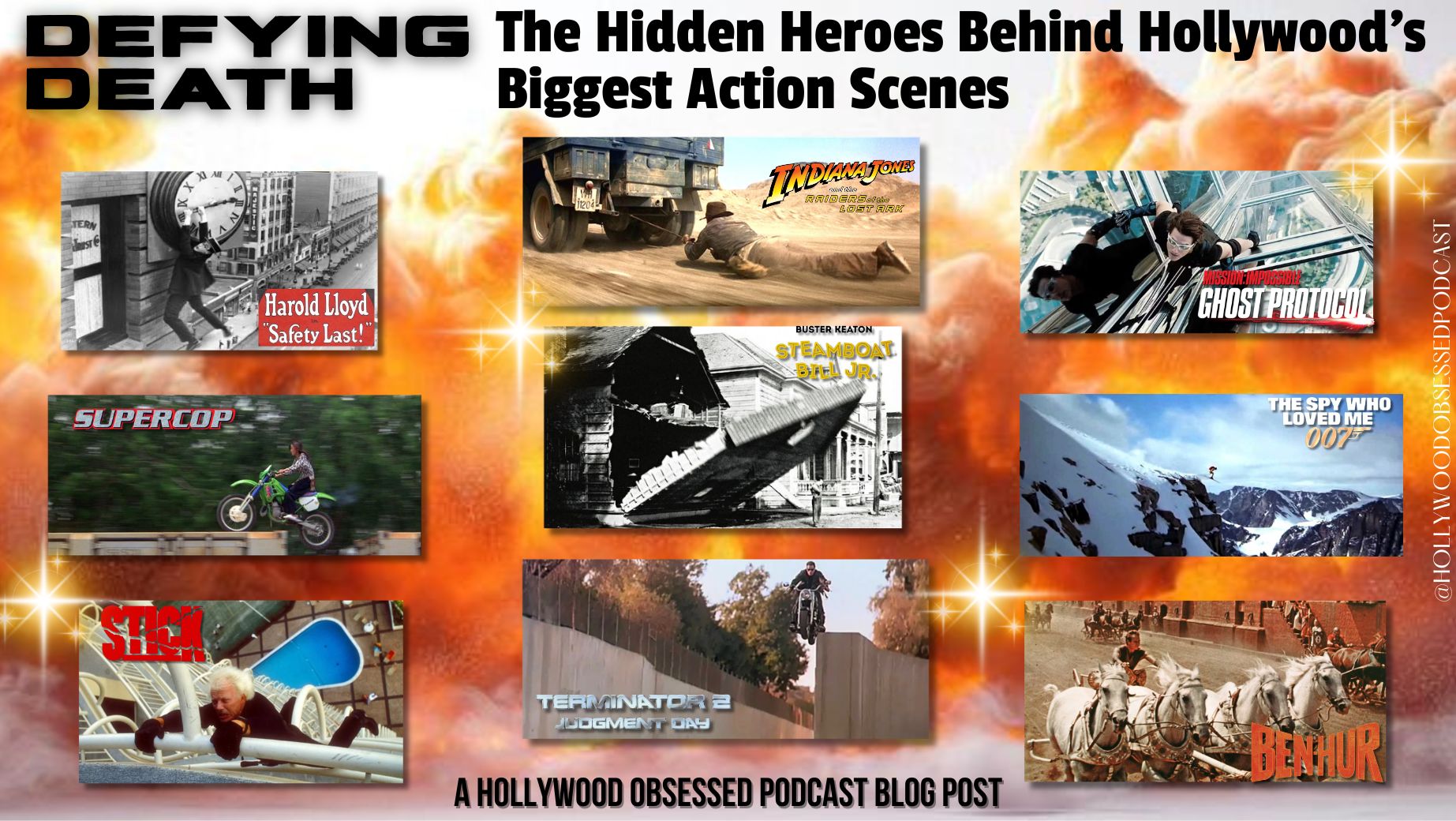
Growing up, going to the movies every weekend felt like climbing aboard the world’s wildest roller coaster. The 1980s exploded with larger-than-life action spectacles—from First Blood and Lethal Weapon to Raiders of the Lost Ark and Terminator 2: Judgment Day. Audiences packed theaters to watch heroes leap off cliffs, crash through windows, race speeding trains, dodge explosions, and somehow walk away with barely a scratch. Those jaw-dropping moments were the reason we bought tickets, grabbed popcorn, and lined up around the block for the next adrenaline-fueled adventure.
But behind every fearless movie hero was an even braver stunt performer risking life and limb to make the impossible look real. Long before CGI took over Hollywood, stuntmen and stuntwomen were literally throwing themselves into danger for our entertainment—jumping from buildings, setting themselves on fire, flipping cars, and enduring punishing fight scenes that left audiences gasping. They were the hidden stars of action cinema, the unsung daredevils whose work helped define movie magic from the earliest days of Hollywood to the blockbuster era of the ’80s and beyond.
That’s why it’s so exciting that the Academy of Motion Picture Arts and Sciences will finally begin honoring stunt performers with an annual Oscar category in time for the Academy Awards’ 100th anniversary. It’s a long-overdue standing ovation for the talented men and women who have spent decades risking everything to give audiences some of the most unforgettable moments in film history.
In celebration of that milestone—and inspired by my recent electrifying two-part conversation with legendary stuntman Peter Kent, who spent 13 years doubling Arnold Schwarzenegger across 14 films beginning with The Terminator on Hollywood Obsessed Podcast Episodes 169 and 170—I thought it would be the perfect time to revisit some of the greatest movie stunts ever captured on film and the incredible stunt performers who made them happen.
So fasten your seatbelt, hold on tight, and prepare for a high-speed ride through some of cinema’s most thrilling stunt spectaculars!
*************************************************
Truck drag scene - Raiders of the Lost Ark (1981)
Is there an adventure film more exciting than Raiders of the Lost Ark? If there is, it would be hard-pressed to match the sheer number of unforgettable stunts packed into Steven Spielberg’s action masterpiece. From the legendary truck drag sequence to the terrifying rolling boulder escape, the film delivered some of the most pulse-pounding moments audiences had ever seen — and decades later, they’re still just as thrilling to watch.
One of the film’s most celebrated action scenes is the incredible truck chase, where Indiana Jones is dragged underneath and behind a speeding Mercedes-Benz truck while trying to rescue the Ark. Much of the dangerous stunt work was performed by legendary stuntman Terry Leonard as a tribute to classic stunt pioneer Yakima Canutt and his groundbreaking work in Stagecoach. Filmed over roughly eight weeks in the blistering Tunisian desert, the production used a specially modified truck with extra clearance and even dug trenches into the road to help safely execute the jaw-dropping sequence. The result remains one of the greatest practical stunt scenes ever filmed.
Then there’s the iconic opening boulder chase — arguably one of the most famous introductions in movie history. After stealing a golden idol from a booby-trapped temple in Peru, Indiana Jones suddenly finds himself sprinting for his life as a gigantic stone boulder comes crashing after him. The “boulder” was actually a hollow prop constructed from fiberglass, wood, and plaster, reportedly measuring between 12 and 22 feet in diameter and weighing several hundred pounds. Amazingly, Harrison Ford performed the stunt himself, outrunning the massive prop multiple times for different camera angles. Spielberg later admitted allowing Ford to do it was probably “foolish,” and one genuine stumble by Ford during filming was so authentic it was left in the final movie.
And of course, the franchise delivered yet another all-time great stunt in Indiana Jones and the Last Crusade when Indiana Jones leaped from a galloping horse onto a moving German tank. The breathtaking stunt was performed by legendary stuntman and coordinator Vic Armstrong, doubling for Harrison Ford. The leap required Armstrong to jump roughly 14 feet while moving at high speed and land perfectly on the rear of the tank — a stunt so spectacular it was later voted one of the Top Ten Film Stunts of All Time by Sky Movies viewers and stunt experts in 2002. Between the truck drag, the boulder chase, and the tank jump, the Indiana Jones films proved that nobody delivered old-school cinematic thrills quite like Indy.
*************************************************
The Jump (Canal Sequence) - Terminator 2: Judgement Day (1991)
When it comes to larger-than-life action movies, few stars have thrilled audiences worldwide quite like Arnold Schwarzenegger. And among all of his explosive blockbusters, none left a bigger impact than Terminator 2: Judgment Day, directed by the master of cinematic spectacle himself, James Cameron.
Set eleven years after the events of The Terminator, the groundbreaking sequel flipped the formula by turning Schwarzenegger’s deadly killing machine into humanity’s protector — and audiences loved every second of it. Bigger, louder, and more ambitious than its predecessor, Terminator 2 raised the bar for action filmmaking with revolutionary visual effects and some of the most unforgettable practical stunts ever captured on film.
Among the film’s many jaw-dropping moments, one stunt stands above the rest: the legendary Harley-Davidson Fat Boy jump into the Los Angeles drainage canal during the film’s iconic chase sequence. Performed by acclaimed stuntman Peter Kent, doubling for Schwarzenegger, the sequence remains one of the most talked-about motorcycle stunts in movie history.
The stunt was no simple trick. Kent had to maneuver a nearly 300-kilogram Harley-Davidson down into the massive concrete canal and execute a dramatic leap that looked impossibly dangerous on screen. To safely achieve the illusion of the motorcycle flying through the air, the bike was suspended and controlled by an intricate system of heavy-duty cables that were later digitally removed — groundbreaking work for the time.
But the canal jump was only one of many high-risk moments Kent performed during the production. Cameron himself described another sequence — in which Kent transferred from a smaller vehicle onto a speeding tanker truck in a single unharnessed shot — as one of the most dangerous stunts he had ever filmed. These practical, real-world stunts are a huge part of what gives Terminator 2 its raw intensity and enduring excitement more than three decades later.
As Schwarzenegger’s longtime stunt double and stand-in, Peter Kent became an essential part of the actor’s on-screen legacy, helping bring many of Hollywood’s biggest action classics to life, including The Terminator, Predator, Commando, Total Recall, True Lies, and Last Action Hero.
If you’d like to hear more behind-the-scenes stories about this unforgettable stunt, along with Peter Kent’s incredible 13-year friendship and working relationship with Schwarzenegger across 14 films, be sure to check out my two-part interview with Kent on Hollywood Obsessed Podcast Episodes 169 & 170.
Listen now!
*************************************************
Burj Khalifa Climb - Mission: Impossible – Ghost Protocol (2011)
During the 2000s, Tom Cruise revived the grand tradition of the larger-than-life Hollywood action blockbuster with the wildly successful “Mission: Impossible” franchise. What made the series truly stand apart, though, was Cruise’s relentless commitment to performing many of the death-defying stunts himself. With every new film, the action became bigger, riskier, and more unbelievable.
Audiences were stunned watching Cruise cling to the side of a real Airbus aircraft during takeoff in Mission: Impossible – Rogue Nation — a terrifying stunt he reportedly performed eight times to get the perfect shot. Then came the now legendary motorcycle cliff jump in Mission: Impossible – Dead Reckoning Part One, where Cruise launched himself off a massive Norwegian cliff before parachuting safely to the ground, creating one of the most talked-about action scenes in modern movie history.
Yet somehow, the franchise still managed to top itself with the breathtaking Burj Khalifa sequence in Mission: Impossible – Ghost Protocol. Seeing Ethan Hunt scaling and dangling from the side of the world’s tallest building instantly became one of the most nerve-shredding moments ever put on screen. At more than 2,700 feet tall, the Burj Khalifa made the sequence feel less like a movie stunt and more like a real-life nightmare unfolding high above Dubai.
In the unforgettable scene, Hunt uses futuristic suction gloves to climb the skyscraper while attempting to infiltrate a secure server room on the 130th floor. Of course, everything goes wrong — one glove malfunctions, brutal winds whip around him, and suddenly Cruise is sprinting, leaping, and clinging to the glass exterior with nothing but open sky beneath him. Although Cruise was safely attached to an elaborate harness and cable system that was digitally erased later, the illusion was so seamless that audiences genuinely felt like they were watching a man risking his life in real time.
Preparing for the stunt required months of intense training alongside professional climbing experts, while director Brad Bird used massive IMAX cameras to heighten every dizzying second of the sequence. Add in scorching desert heat, punishing winds, and painfully restrictive harnesses, and the result became one of the most physically demanding action scenes ever filmed. To this day, the Burj Khalifa climb remains one of the most iconic stunts in cinema history — and it’s still almost impossible to watch without gripping the edge of your seat in panic. Yikes!
*************************************************
The Ski Jump - The Spy Who Loved Me (1977)
I’ve always loved the James Bond films! They’re stylish, thrilling, wildly entertaining, and always packed with those jaw-dropping moments that leave you asking, “How did they possibly pull that off?” From exotic locations and daring escapes to outrageous gadgets and death-defying action, the Bond franchise has mastered the art of delivering pure cinematic excitement for generations of movie fans.
One unforgettable example is the legendary ski jump in the 1977 Bond classic The Spy Who Loved Me. Widely regarded as one of the greatest stunts ever filmed, the sequence featured stuntman Rick Sylvester skiing off the edge of a towering cliff before plunging into a terrifying free fall and finally deploying a spectacular Union Jack parachute. Sylvester performed the stunt atop Mount Asgard on Baffin Island in Nunavut, Canada — a massive peak standing roughly 6,611 feet high. The dangerous jump was captured in a single take under brutal weather conditions, and incredibly, nearly every camera crew lost sight of Sylvester as he disappeared into the abyss. Only one camera successfully captured the now-iconic long shot that audiences still talk about nearly fifty years later.
When the parachute finally opened on screen, moviegoers erupted with excitement. The moment was so electrifying that audiences reportedly leapt to their feet cheering in theaters around the world — including none other than Prince Charles himself. It remains one of the most celebrated moments in Bond history and a perfect example of why the 007 films continue to captivate audiences with their blend of glamour, danger, and unforgettable stunt work.
*************************************************
The High Fall - Stick (1985)
One of the most terrifying and unforgettable stunts ever captured on film appears in the 1985 crime thriller Stick, starring and directed by Burt Reynolds. The jaw-dropping sequence features legendary stuntman Dar Robinson plunging backward off the 22nd floor of a Miami high-rise while firing a gun mid-fall — a moment so shocking and realistic that audiences could hardly believe what they were seeing. Even decades later, the stunt still feels absolutely insane to watch, thanks to the dizzying camera angles and Robinson’s fearless commitment to realism.
What made the stunt truly revolutionary was how it was achieved. Unlike traditional high falls that relied on massive inflatable airbags hidden below, Robinson performed the stunt using his own groundbreaking invention known as “The Decelerator,” a sophisticated wire-rig system designed to gradually slow a stunt performer’s descent using drag-line cables. The innovative setup eliminated the need for a visible airbag on the pavement below, allowing filmmakers to shoot directly downward from the rooftop and create an uninterrupted, heart-stopping view of Robinson plummeting toward the street. The result was a level of realism and danger audiences had never experienced before, instantly cementing the sequence as one of the most influential stunt achievements in Hollywood history.
Dar Robinson was widely regarded as one of the greatest stunt performers who ever lived — a fearless innovator who constantly pushed the limits of what could safely be accomplished on screen. In addition to his unforgettable work in Stick, Robinson also performed the legendary 220-foot freefall in Sharky’s Machine, another classic collaboration with Reynolds that earned him a place in the record books. Tragically, Robinson died in a motorcycle accident in 1986 at the age of just 39, cutting short one of the most extraordinary careers in stunt history. His impact on the industry was so profound that the hit action film Lethal Weapon was dedicated to his memory — a fitting tribute to a man who quite literally risked his life to thrill movie audiences around the world.
*************************************************
The House Wall Collapse - Steamboat Bill, Jr. (1928)
With all the cutting-edge technology, padded safety rigs, and CGI wizardry used in movies today, it’s almost impossible to imagine the kind of wild, death-defying stunts actors pulled off during the silent film era. But back in the 1920s, filmmakers didn’t have green screens or digital effects to save the day—what audiences saw was often terrifyingly real. One of the most legendary examples comes from the 1928 silent comedy Steamboat Bill, Jr., when silent film icon Buster Keaton performed what is still considered one of the most dangerous stunts in cinema history. During the film’s massive cyclone sequence, the entire front wall of a two-ton house crashes straight down onto Keaton. Miraculously, he survives because he’s standing perfectly still in the exact spot where an upstairs window opening falls around his body by mere inches.
What makes the stunt so unbelievable is that there were no special effects, no hidden harnesses, and no lightweight props. That gigantic wall was the real deal—solid timber, weighing nearly two tons. The gap between Keaton’s shoulders and the window frame was only about two inches, meaning one tiny mistake could have killed him instantly. Crew members held the façade upright with ropes before releasing it, while Keaton stood frozen in place, eyes forward, trusting pure precision and nerves of steel. Nearly a century later, the stunt still leaves audiences stunned because it captures something modern filmmaking rarely risks anymore: a moment where cinematic magic and real danger collided in breathtaking fashion.
*************************************************
The Chariot Race - Ben-Hur (1925/1959)
One of the most expensive and dangerous sequences ever filmed, this race involved 82 horses and five weeks of shooting. A particularly famous moment occurred when a stuntman was accidentally launched over a chariot but managed to pull himself back in.
While the 1959 version is famous, the 1925, 1959, and many subsequent versions are known for dangerous chariot racing that pushed boundaries, often using many stuntmen and resulting in injuries. widely considered one of the most famous action sequences in cinematic history. Clocking in at approximately nine to eleven minutes, this practical-effects masterpiece was filmed at Cinecittà Studios in Rome on an 18-acre arena track—the largest movie set ever constructed at the time.
Stars Charlton Heston and Stephen Boyd trained for months to handle the four-horse teams themselves; they performed a significant portion of their own driving. : A standout moment occurs when Heston’s stunt double, Joe Canutt, was accidentally thrown over the front of his chariot. He managed to hang on and climb back in, a real near-disaster that director William Wyler kept in the final film because it looked so authentic.
The scene remains a benchmark for action choreography, contributing significantly to Ben-Hur winning a record 11 Academy Awards. Despite long-standing myths, no horses or stuntmen were killed during the 1959 production, unlike the tragic 1925 silent version where many horses perished.
*************************************************
Trans Am jump over the Mulberry Bridge - Smokey and the Bandit (1977)
Few movie stunts are as legendary — or as downright fun — as the iconic Trans Am bridge jump in the 1977 classic Smokey and the Bandit. Roaring across the screen roughly midway through the film, the unforgettable leap instantly became one of the most celebrated car stunts in cinema history. In the movie, the scene takes place in Arkansas as the Bandit makes his daring escape from Sheriff Buford T. Justice, but the actual filming location was the Flint River in Jonesboro, Georgia. Conveniently for the filmmakers, the real bridge had already been partially dismantled, creating the perfect setup for a jaw-dropping high-speed jump.
To pull off the massive leap, the production team built a specially modified Pontiac Firebird Trans Am equipped with a monstrous 750-horsepower NASCAR engine. Legendary stunt driver Alan Gibbs, doubling for Burt Reynolds, launched the screaming black-and-gold Trans Am across the roughly 150-foot gap in one unforgettable shot. The stunt was so extreme that the car was completely destroyed upon impact after landing — but the footage captured was pure movie magic.
Adding to the spectacle, the Trans Am was reportedly fitted with a hidden booster rocket similar to the ones used by daredevil Evel Knievel to guarantee the car cleared the broken bridge. The result was one of the most thrilling practical stunts ever filmed and a defining moment of 1970s action cinema. Nearly fifty years later, that soaring Trans Am still represents everything audiences loved about old-school Hollywood stunt work: real danger, real cars, and one very fearless driver pushing the limits for the perfect shot.
*************************************************
Under-the-Horse Scene - Stagecoach (1939)
The famous “under-the-horse” stunt in Stagecoach is still regarded as one of the greatest — and most dangerous — stunts ever performed on film. Executed by legendary stuntman Yakima Canutt while doubling as an Apache warrior, the breathtaking sequence shows Canutt leaping onto the lead horses of a speeding stagecoach, being “shot” by the Ringo Kid, played by John Wayne, and then falling directly beneath the thundering horses and moving coach. Even by today’s standards, the stunt is absolutely jaw-dropping.
Canutt later explained that the horses actually had to run at full speed to keep them moving in a perfectly straight line so they wouldn’t accidentally step on him. As the stagecoach passed overhead, he had to tightly pull his arms across his chest and stomach to stay low enough for the chassis to clear his body. Under the masterful direction of John Ford, the sequence became a landmark moment in action filmmaking and influenced generations of stunt performers. Decades later, Steven Spielberg famously paid tribute to the stunt in Raiders of the Lost Ark when Indiana Jones performs a similarly terrifying move beneath a speeding truck.
*************************************************
Shopping Mall Pole Slide - Police Story (1985)
The legendary shopping mall pole slide in Police Story is widely considered one of the most dangerous and breathtaking stunts ever captured on film. Performed by the fearless Jackie Chan at Hong Kong’s Wing On Plaza, the unforgettable sequence features Chan’s character, Ka-Kui, leaping from an upper-floor railing onto a metal pole wrapped in decorative lights before sliding nearly five stories to the ground below. Even more astonishing, the stunt was performed without a safety net, harness, or wires. To make sure every second of the chaos was captured perfectly, the production filmed the stunt in one continuous take using an incredible 15 cameras simultaneously.
What makes the sequence even more unbelievable is how dangerous it truly was behind the scenes. The decorative lights were plugged directly into the mall’s power grid, meaning Chan was repeatedly electrocuted as exploding bulbs shattered around him during the descent. The intense friction and heat from the lights caused second-degree burns to his hands, and after crashing through a pane of glass onto a kiosk below, Chan suffered a dislocated pelvis and serious back injuries. Amazingly, he still managed to stand up immediately and finish the scene — a moment left in the final film. To this day, many critics and stunt professionals consider the mall sequence the absolute peak of practical action filmmaking. Watching it still feels like witnessing someone risk their life for the perfect shot. Wow indeed!
*************************************************
The Clock Hanging - Safety Last! (1923)
The iconic image of Harold Lloyd dangling from a giant clock high above a busy city street in Safety Last! remains one of the most famous — and anxiety-inducing — moments in cinema history. Even nearly 100 years later, the sequence still has audiences clutching their seats in panic. Amazingly, the illusion of Lloyd hanging hundreds of feet in the air was created through an ingenious use of forced perspective. The “building” was actually a series of facades constructed atop progressively taller buildings around Los Angeles, allowing filmmakers to capture the real city skyline far below while Lloyd performed the stunt only a few stories above the ground.
Of course, that doesn’t make the stunt any less incredible. A hidden safety platform with mattresses sat roughly 15 feet below Lloyd, just out of the camera’s frame, but the danger and tension still feel completely real on screen. What makes the achievement even more astonishing is that Lloyd performed these daring stunts despite having lost his thumb and index finger on his right hand years earlier in a prop bomb accident. Wearing a prosthetic glove to conceal the injury, Lloyd climbed, dangled, and swung from the massive clock face with fearless precision and perfect comic timing. The result is one of the most brilliant and suspenseful scenes ever filmed — a true masterpiece of silent-era filmmaking that still leaves viewers breathless today. Bravo, Mr. Lloyd. We’re still applauding a century later.
*************************************************
Motorcycle onto Moving Train - Police Story 3: Supercop (1992)
The jaw-dropping motorcycle jump onto a moving train in Police Story 3: Supercop is still considered one of the boldest and most exciting stunts ever performed in action movie history. Even more incredible? It was performed by Academy Award-winning actress Michelle Yeoh herself — with no stunt double, no CGI, and no safety wires. In the unforgettable sequence, Yeoh rides a dirt bike up a steep hillside ramp before launching herself onto the roof of a moving steam train, somehow managing to land and slide the motorcycle safely across the top of the carriages. It’s the kind of stunt that makes audiences instantly sit forward and yell, “There’s no way she actually did that!” But she absolutely did.
What makes the feat even more astonishing is that Yeoh reportedly had never ridden a motorcycle before training for the scene. Director Stanley Tong later confirmed the stunt was completely practical, making Yeoh’s fearless performance all the more legendary. Her commitment to performing dangerous stunts reportedly even pushed Jackie Chan to raise the bar himself, leading to his own insane helicopter ladder sequence later in the film. And the train jump wasn’t even Yeoh’s only near-disaster — she also performed a terrifying stunt involving rolling from a moving van onto Chan’s convertible that nearly turned fatal. Watching Police Story 3: Supercop today, it’s impossible not to be blown away by Yeoh’s courage, athleticism, and sheer screen presence. She didn’t just steal scenes in this movie — she cemented herself as total bad ass and one of the greatest action stars of all time.
*************************************************
Helicopter Drop - Highpoint (1982)
One of the most astonishing stunt sequences ever filmed took place in the 1982 action thriller Highpoint, where legendary stuntman Dar Robinson pushed the limits of what audiences thought was humanly possible. While Robinson had already set a world record in 1979 with a 311-foot helicopter drop into an airbag, Highpoint featured the stunt that truly cemented his place in movie history: an unbelievable leap from Toronto’s towering CN Tower. Doubling for Christopher Plummer, Robinson launched himself from the tower in what was then considered the highest free-fall stunt ever performed for a motion picture.
The death-defying jump sent Robinson plummeting more than 1,100 feet through open air before he deployed a concealed parachute hidden beneath his business suit at the very last possible moment — just a few hundred feet above the ground. For six terrifying seconds, audiences watched what looked like a genuine fatal fall before Robinson safely landed on his feet. The stunt was performed years before CGI existed, making every heart-stopping second completely real. Robinson reportedly earned between $100,000 and $150,000 for the single stunt — an enormous payday at the time — but one look at the sequence and it’s easy to understand why. Even today, the CN Tower jump remains one of the greatest practical stunts ever captured on film, and it still leaves audiences staring at the screen saying, “WOW!”
*************************************************
Now that you’ve read about these fearless men and women who have literally risked life and limb to entertain movie audiences for more than 100 years, it’s time to go even deeper into the wild world of Hollywood stunt work. Be sure to check out my two-part Hollywood Obsessed podcast interview (Episodes 169 & 170) with legendary stuntman Peter Kent — the man who stood shoulder-to-shoulder with Arnold Schwarzenegger and helped bring some of the biggest, boldest, and most death-defying action scenes in movie history to life. Inducted into the Hollywood Stuntmen Hall of Fame, Peter’s incredible journey through the world of action cinema is nothing short of extraordinary.
From brutal fight scenes and explosive crashes to the grueling physical punishment stunt performers endure behind the scenes, Peter shares unbelievable firsthand stories about what it truly takes to survive — and succeed — as one of Hollywood’s elite stuntmen. Trust me, by the end of these interviews, you’ll have a whole new appreciation for the unsung heroes who make movie magic possible. So strap in, hold on tight, and enjoy the ride!
Listen now!
Episode 169 – HERE
Episode 170 – HERE

Growing up on the East Coast, Tony Miros developed a passion for acting at an early age, studying at New York City’s renowned Herbert Berghof (HB) Studio. He later attended Walnut Hill School for the Performing Arts in Natick, Massachusetts, where he trained in theater, dance, and voice.
Returning to New York to complete high school at The Beekman School, Tony began working professionally, appearing in commercials and making his Off-Broadway debut in "The House with the Seven Balconies" (La Casa de los Siete Balcones) alongside his mother, acclaimed actress and radio talk show host Gilda Mirós.
Tony continued his theater studies at Whittier College in Southern California before pivoting away from acting and relocating to Miami Beach, where he launched a successful career in public relations. It was there that he found his distinctive voice as a writer, creating the popular nightlife column "Beyond the Velvet Rope" for Miami Metro Magazine. The column established him as a celebrated South Beach personality, earning him the moniker “Mr. Nightlife.” Over the past two decades, Tony has built a diverse writing career, contributing to national and international publications including Angeleno Magazine, ReFresh Magazine (UK), and Time Out.
After moving to Los Angeles in 2005, Tony joined Warner Bros. Studios as a VIP Tour Guide before transitioning into casting at the Emmy Award-winning Bunim/Murray Productions. There, he worked on major series including MTV’s "The Real World" (Denver, Sydney, Hollywood), "Road Rules: … Read More
Trivia - Exorcist II The Heretic